Mobile Interface
A comprehensive guide to using the konn3kt mobile web application.
1. Home Dashboard
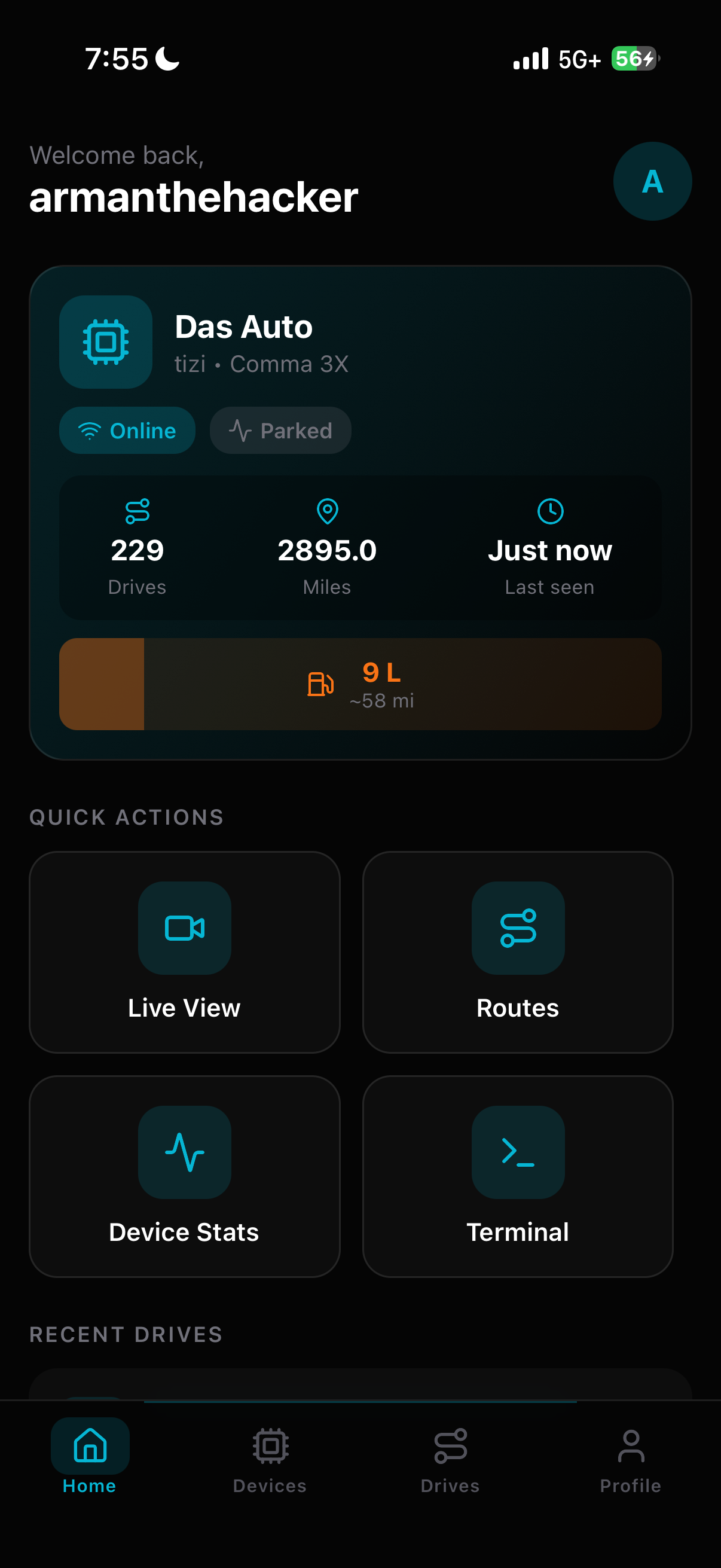
What it is:
The Home tab is your central hub when accessing konn3kt from a mobile device. It provides an immediate overview of your primary IQ.Pilot device.
How to use it:
- Status Card: Instantly check if your vehicle is Online or Parked. It displays your total drives, total miles, and current fuel/energy level.
- Quick Actions: Four large buttons give you immediate access to your most frequently used tools: Live View, Routes, Device Stats, and the Terminal.
- Bottom Navigation: Use the bottom bar to switch between Home, Devices, Drives, and your Profile.
2. Device Management & Actions
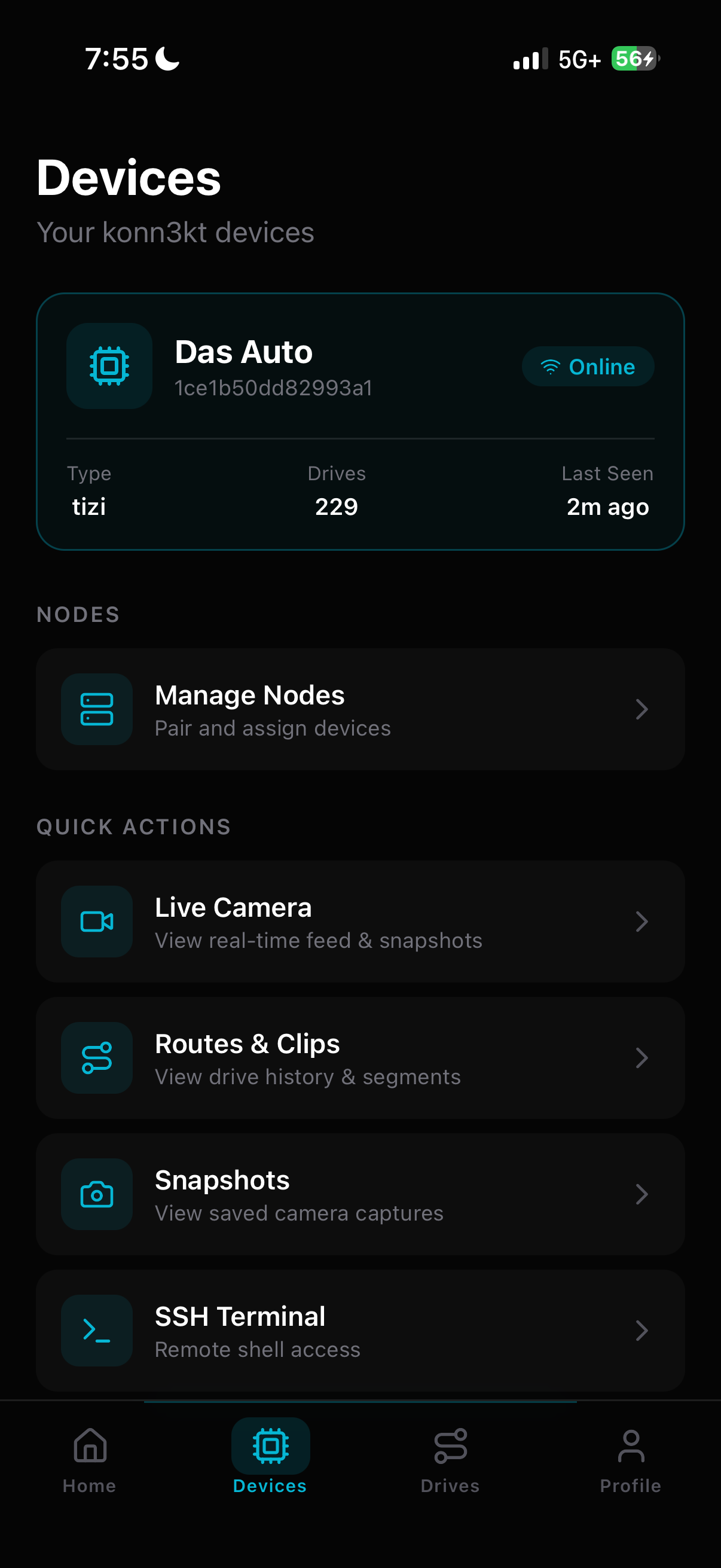
What it is:
The Devices tab provides deep access to a specific piece of hardware. It lists every available tool and configuration option for the selected device.
How to use it:
- Device Selector: The top card shows the currently selected device. If you have multiple devices, you can manage them here.
- Nodes: Tap Manage Nodes to configure any self-hosted storage servers associated with this device.
- Media Actions: Tap Live Camera to start a stream, or Routes & Clips / Snapshots to review past media.
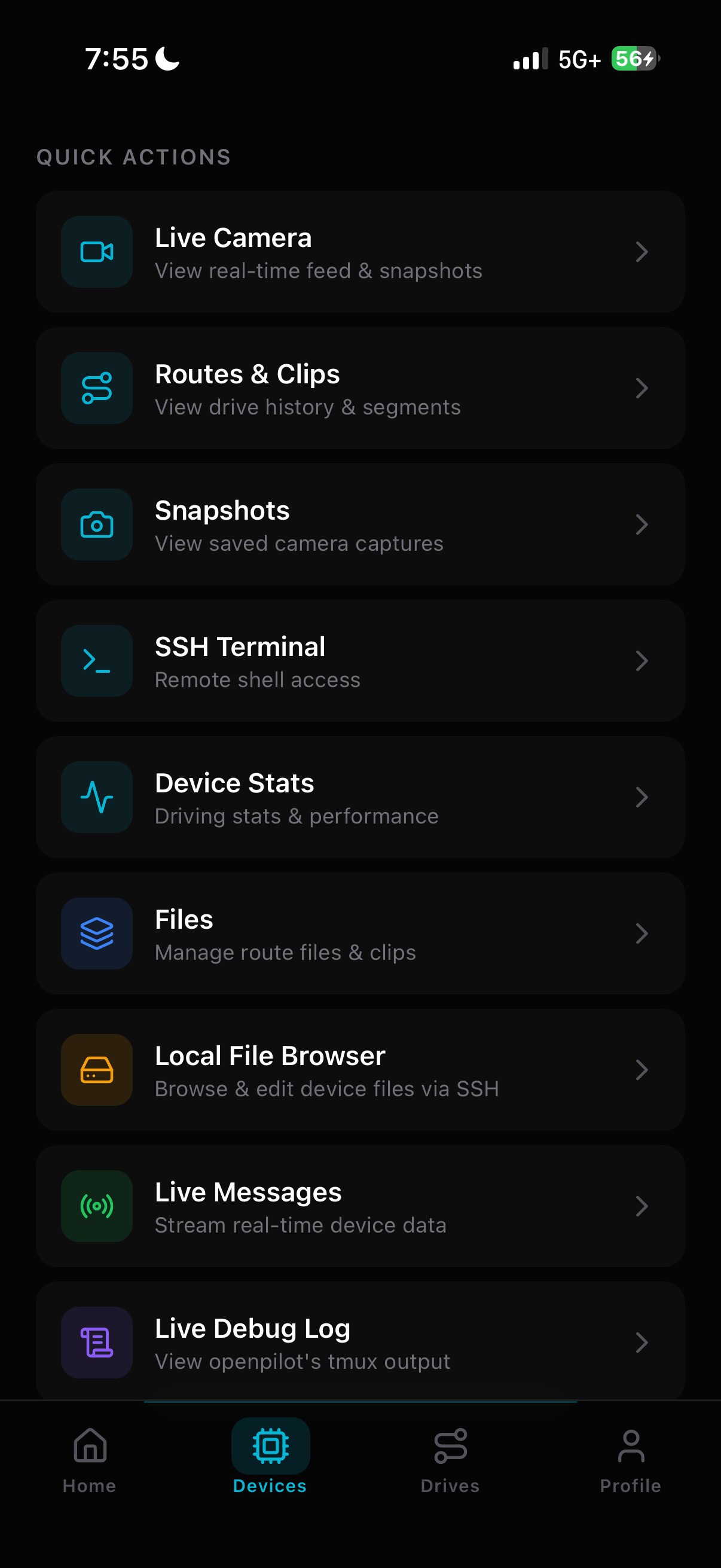
Advanced Tools:
Scrolling down the Devices list reveals professional-grade management tools formatted for mobile:
- SSH Terminal: Opens a secure shell directly in your mobile browser to run Linux commands on your device.
- Local File Browser: Navigate your device's internal storage (e.g.,
/data/media) remotely. - Live Messages & Debug: Stream raw system bus data or view the device's tmux output in real-time for troubleshooting.
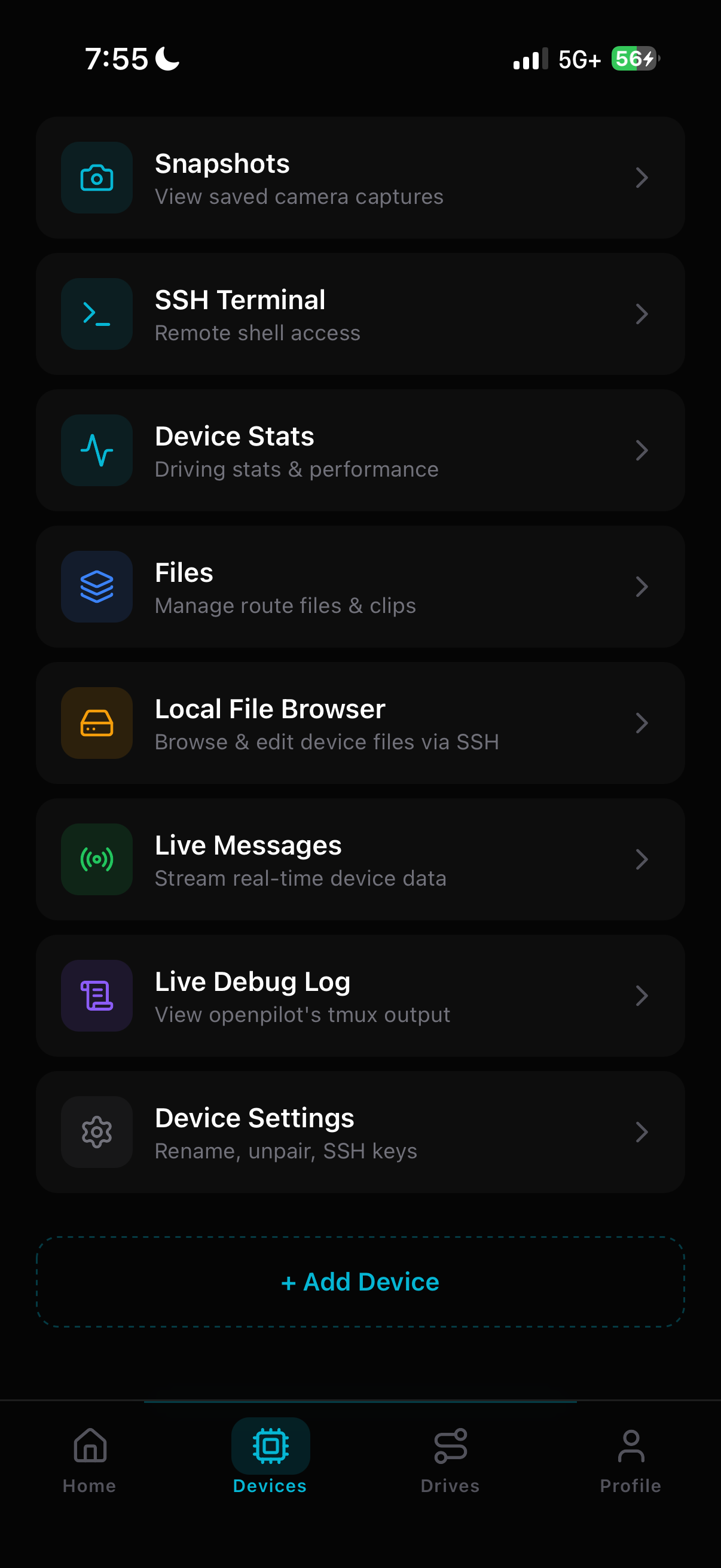
Settings & Pairing:
At the bottom of the list, you'll find system settings.
- Device Settings: Tap here to rename your vehicle, manage SSH keys, adjust system toggles, or unpair the device.
- + Add Device: Use this button to initiate a new pairing sequence (QR Code or Manual) right from your phone.
3. Live View Streaming
What it is:
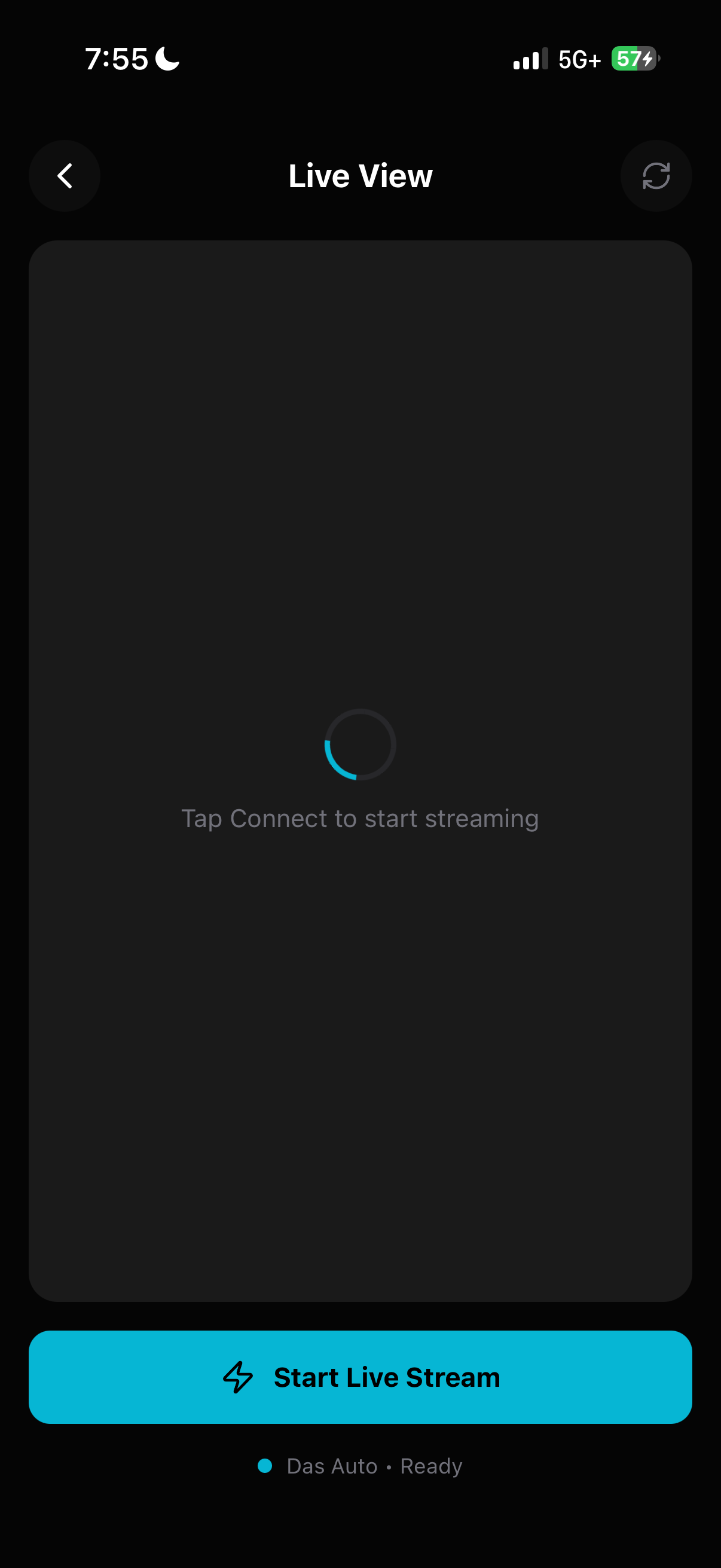
The Live View interface is optimized for mobile screens, allowing you to monitor your car's cameras from anywhere.
How to use it:
- When you open Live View, the stream is paused to save data.
- Tap the large blue Start Live Stream button at the bottom of the screen to initiate a secure peer-to-peer connection with your IQ.Pilot device.
Connection States:
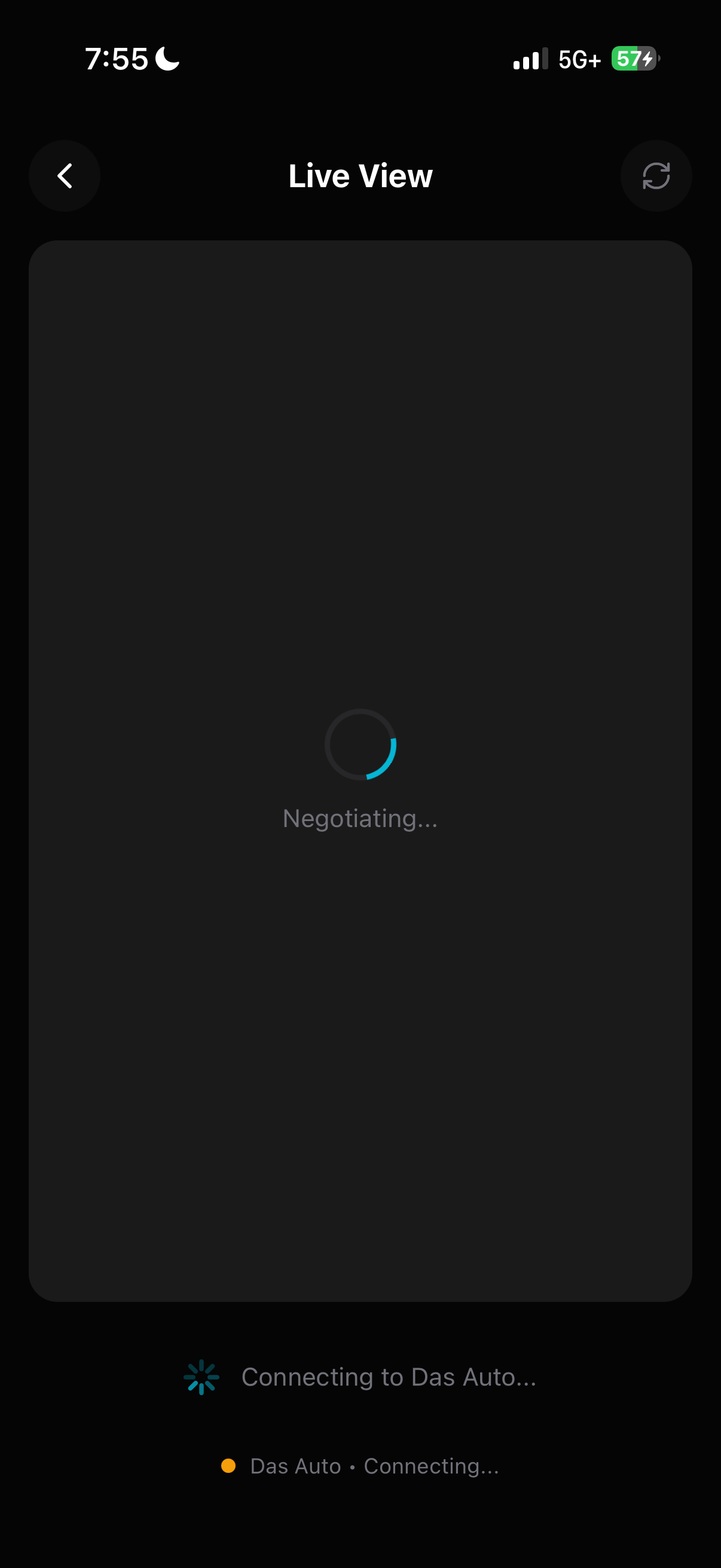
While connecting, the app will guide you through the process:
- Negotiating... indicates that konn3kt is currently establishing an encrypted bridge to your vehicle.
- Once connected, the screen will populate with the live camera feed, and remote vehicle controls (if compatible) will appear.
4. Active Live Stream
What it is:
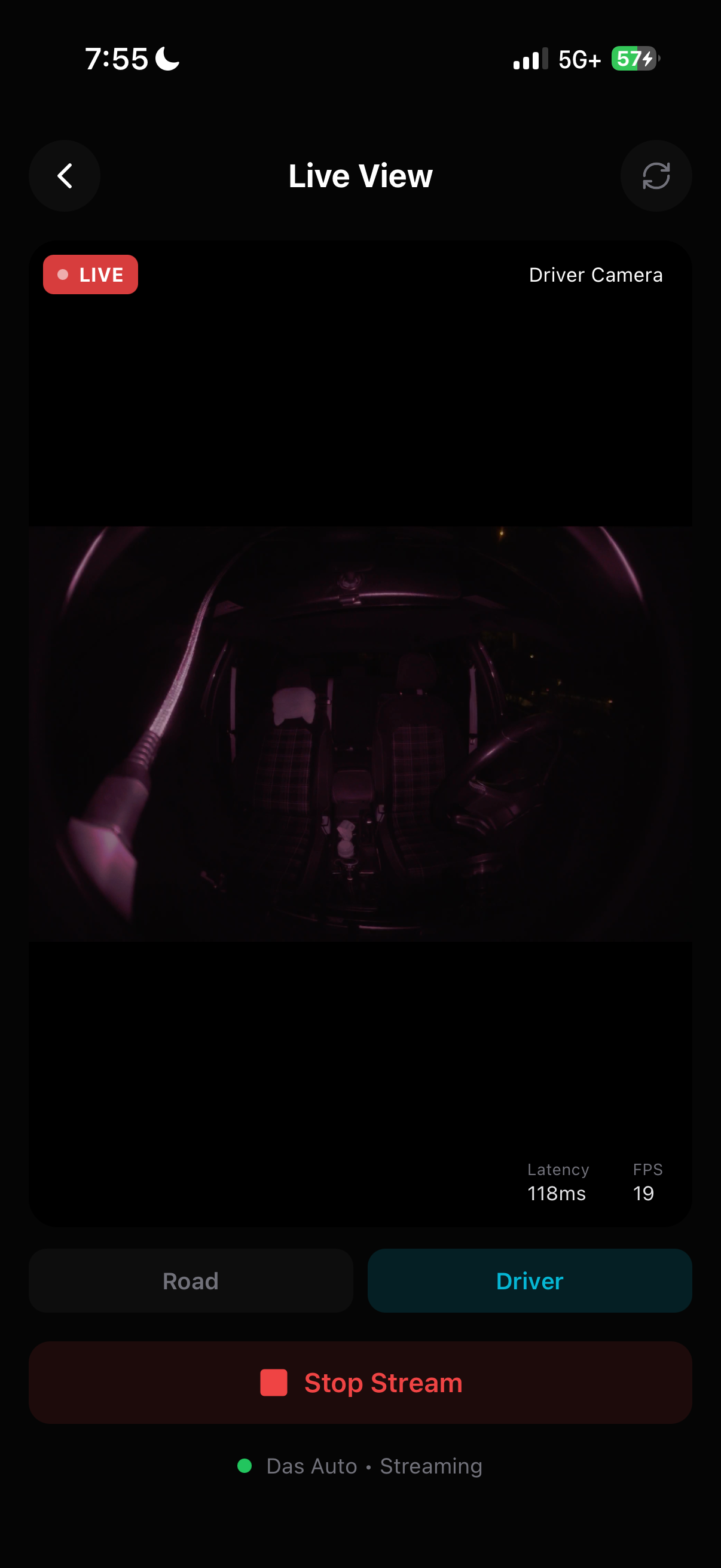
The active streaming view provides a real-time window into your vehicle via a secure, low-latency connection.
How to use it:
- Camera Switcher: Use the Road and Driver buttons at the bottom to toggle between the forward-facing and interior-facing cameras.
- Telemetry Overlay: The bottom right corner displays real-time stream telemetry, showing the connection Latency (e.g., 118ms) and the current Frames Per Second (FPS).
- Stop Stream: Tap the red Stop Stream button to close the connection and save data.
5. Routes & Clips
What it is:
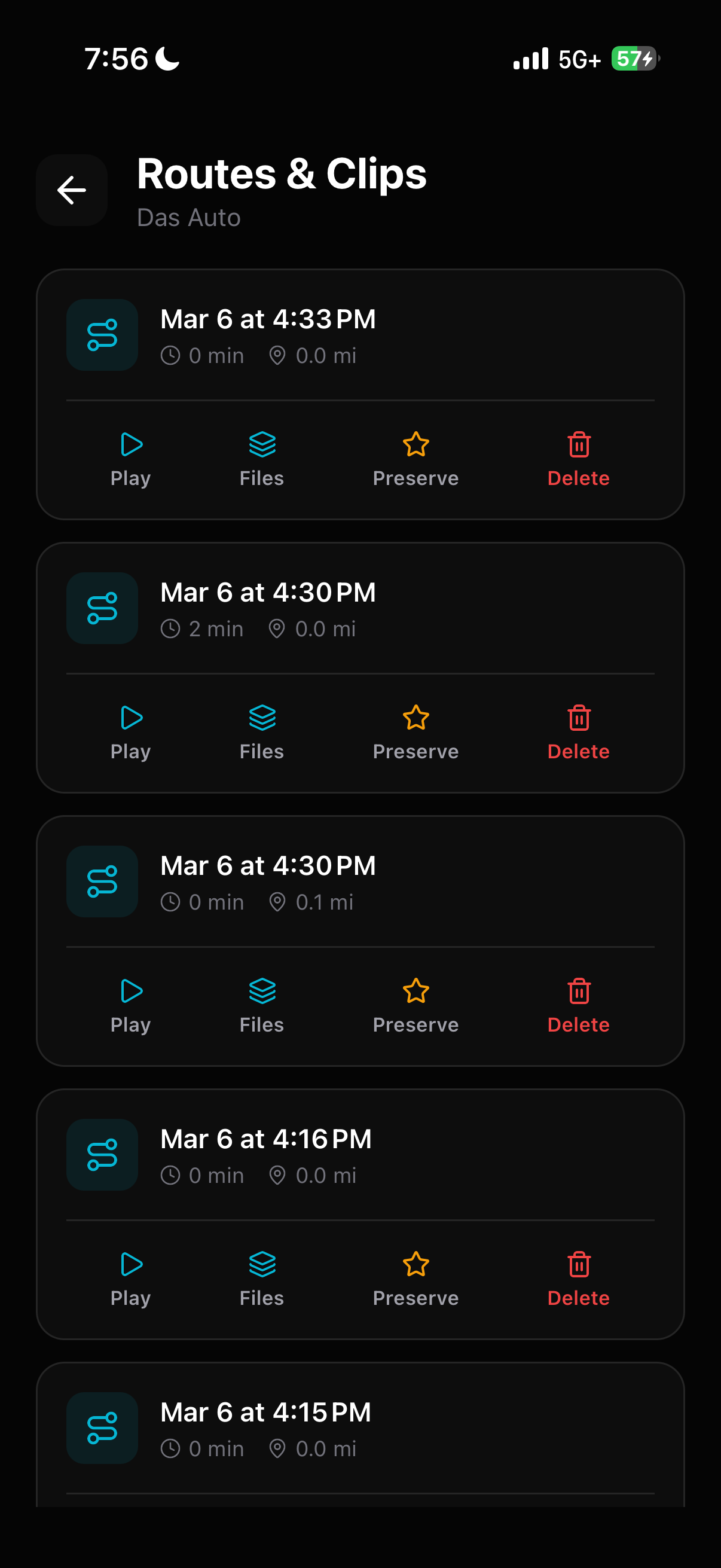
A chronological list of all drives recorded by your IQ.Pilot device, formatted for easy scrolling on a mobile screen.
How to use it:
- Drive Cards: Each card displays the date, time, duration, and distance of a specific trip.
- Quick Actions: Under each drive, you have four immediate actions:
- Play: Jump straight into the video playback and map view for that route.
- Files: Open the detailed data segment view to download raw logs or video files.
- Preserve: Star the route to protect it from automatic deletion.
- Delete: Permanently remove the route data from the cloud.
6. File Management
What it is:
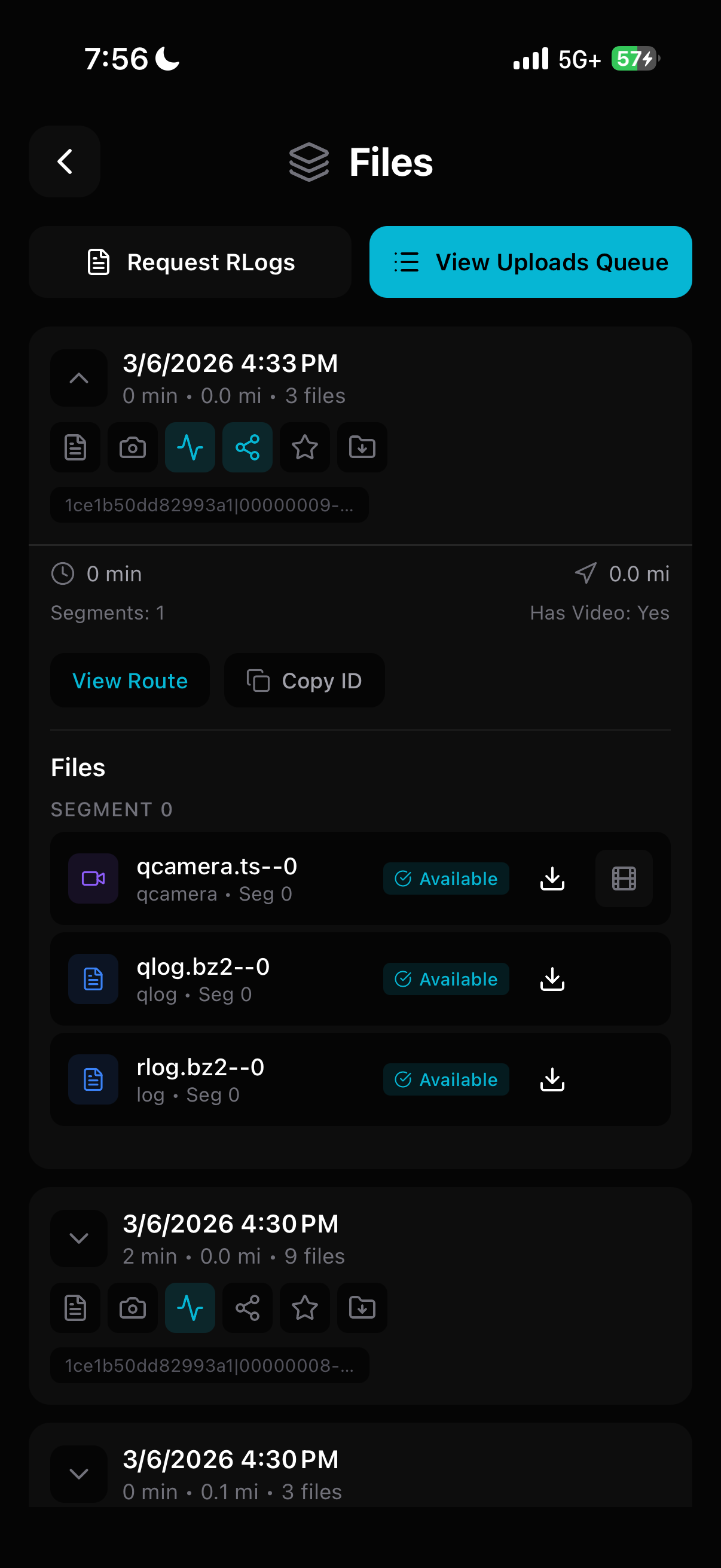
The detailed file explorer for a specific route. This allows you to interact with the raw data segments captured during a drive.
How to use it:
- Data Requests: Use the buttons at the top to Request RLogs (high-resolution logs) or View Uploads Queue to see what your device is currently sending to the server.
- Segment View: Each drive is broken down into minute-long segments. You can expand a segment to see the individual files (qcamera, qlog, rlog).
- Downloads: Tap the download icon next to any file (e.g.,
qcamera.ts--0) to save it directly to your mobile device.
7. Device Stats & Health
What it is:
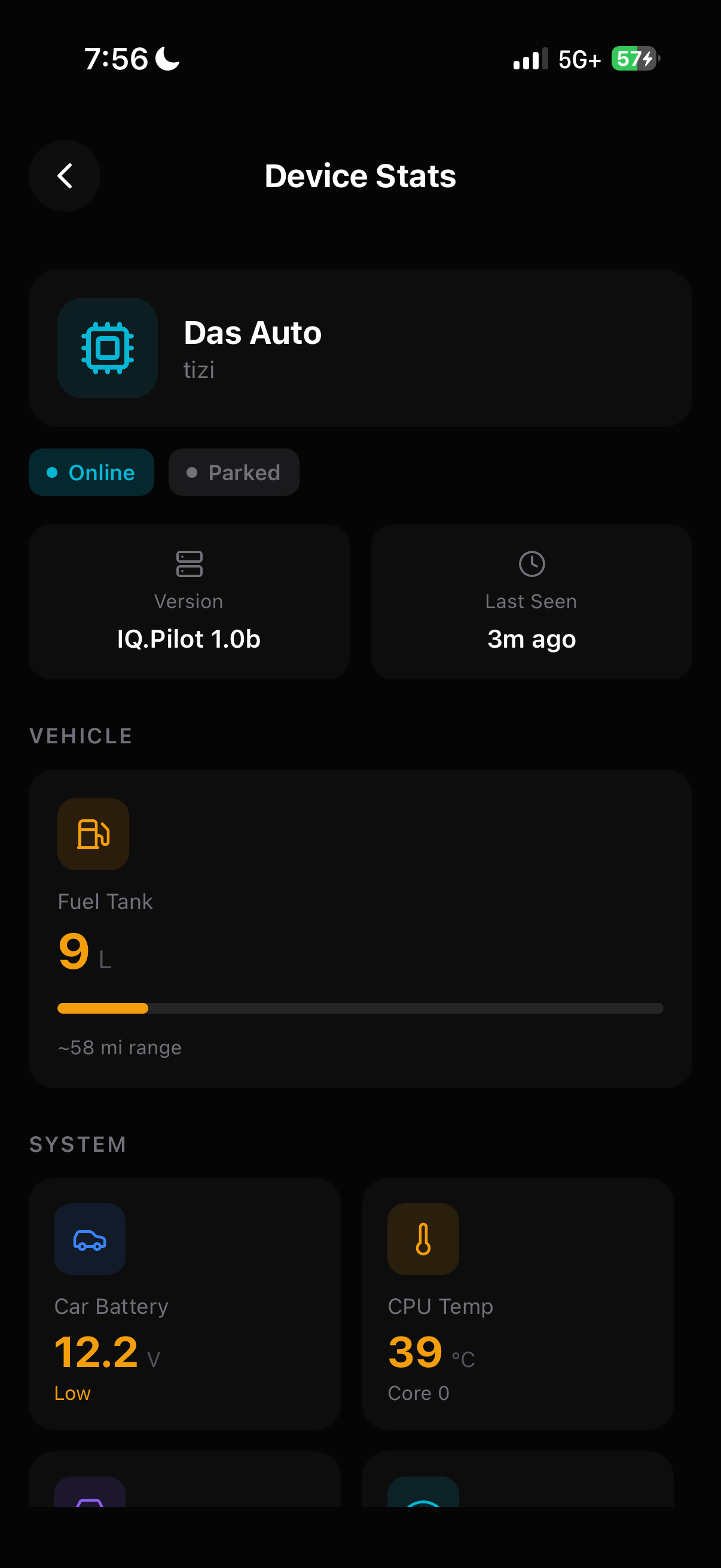
The Device Stats page provides a comprehensive breakdown of your hardware's health and lifetime usage metrics.
How to use it:
- Version Info: Check the exact IQ.Pilot version running on your device (e.g.,
IQ.Pilot 1.0b) and when the device was "Last Seen" by the server. - Vehicle Data: Monitor specific vehicle states like the Fuel Tank level or EV battery range.
- System Health: Keep an eye on the Car Battery voltage (to prevent a dead battery) and the CPU Temp (to ensure the device isn't overheating).
Detailed Metrics:
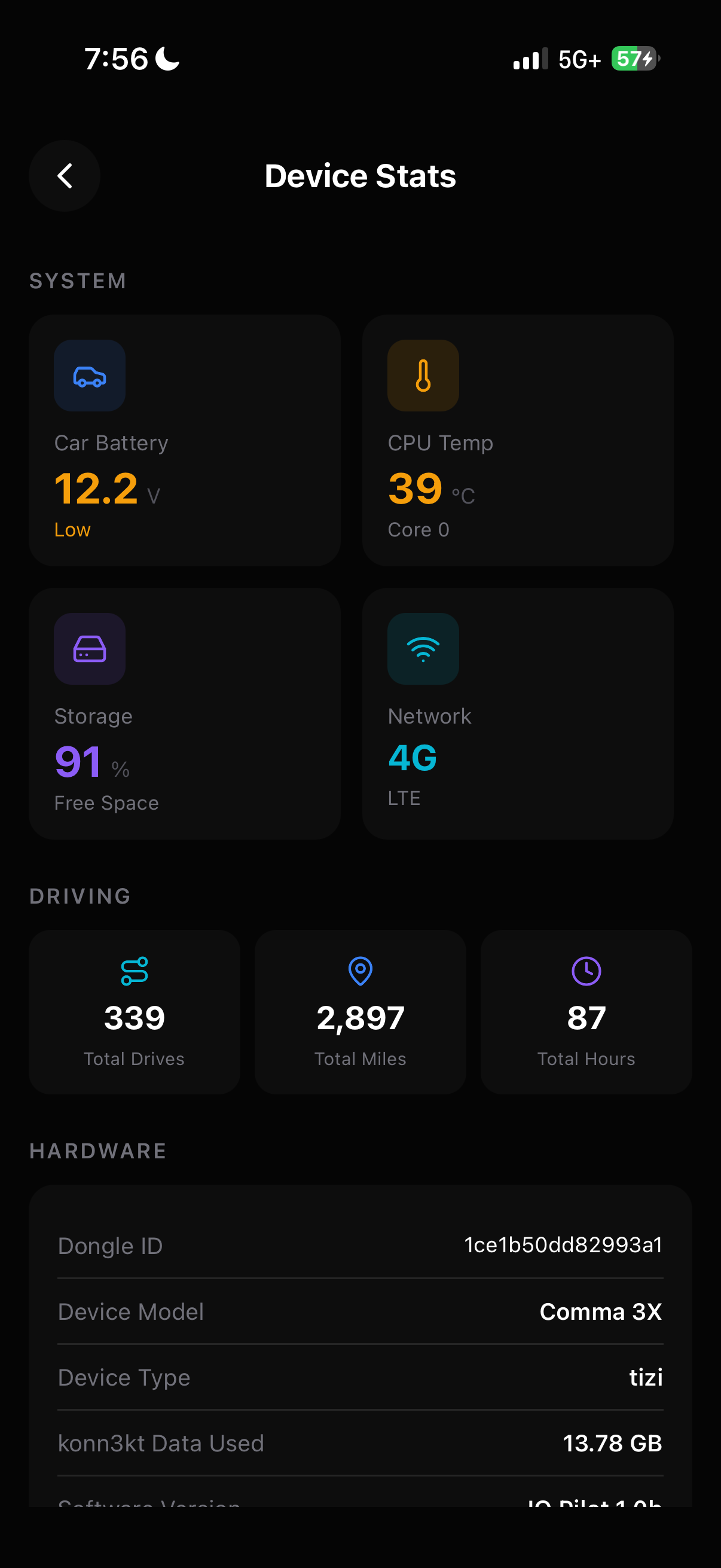
Scrolling down the stats page reveals aggregate data and hardware identifiers.
- Storage & Network: Check your remaining free space (e.g., 91%) and the active connection type (e.g., 4G LTE).
- Driving Totals: View your lifetime Total Drives, Total Miles, and Total Hours.
- Hardware Info: Find your Dongle ID, Device Model (e.g., Comma 3X), and the total amount of konn3kt cloud data you have used.
7. Device Stats & Health (Continued)
Detailed Metrics (Continued):
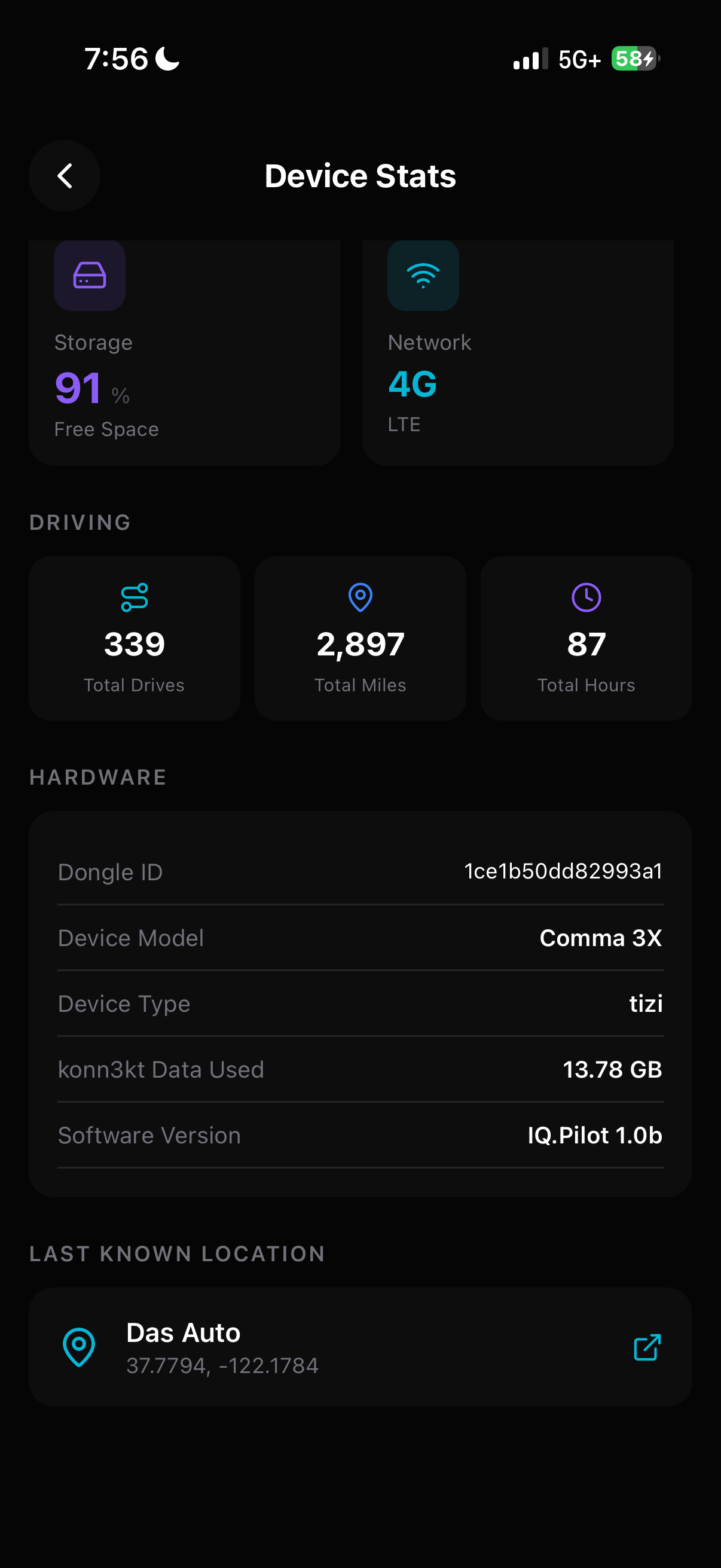
At the bottom of the device stats page, you can find the final critical details about your hardware.
- Hardware Info: Find your 16-character Dongle ID. This is your device's unique serial number on the konn3kt network.
- Cloud Usage: View the total amount of data (e.g., 13.78 GB) your device has uploaded to the konn3kt servers.
- Last Known Location: A quick link to open your vehicle's last reported GPS coordinates in your phone's native mapping application (Apple Maps or Google Maps).
8. Secure Web Terminal
What it is:
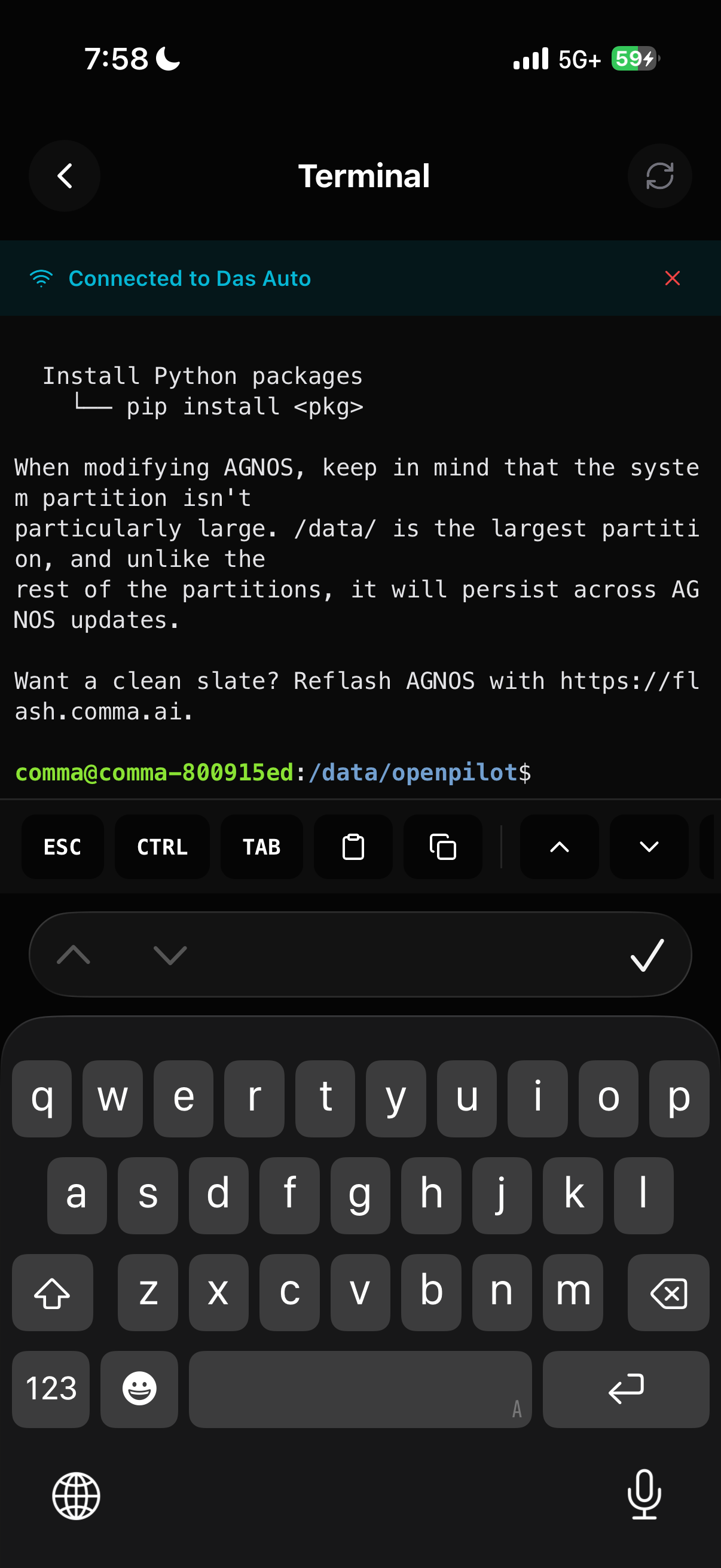
The Web Terminal provides full SSH access to your IQ.Pilot device directly within your mobile browser. No external apps required.
How to use it:
- When you open the Terminal from the Quick Actions menu, konn3kt establishes an encrypted tunnel using the public key you provided during pairing.
- The terminal opens directly into the
/data/openpilotdirectory, giving you immediate access to the core software environment.
Mobile Keyboard Shortcuts:
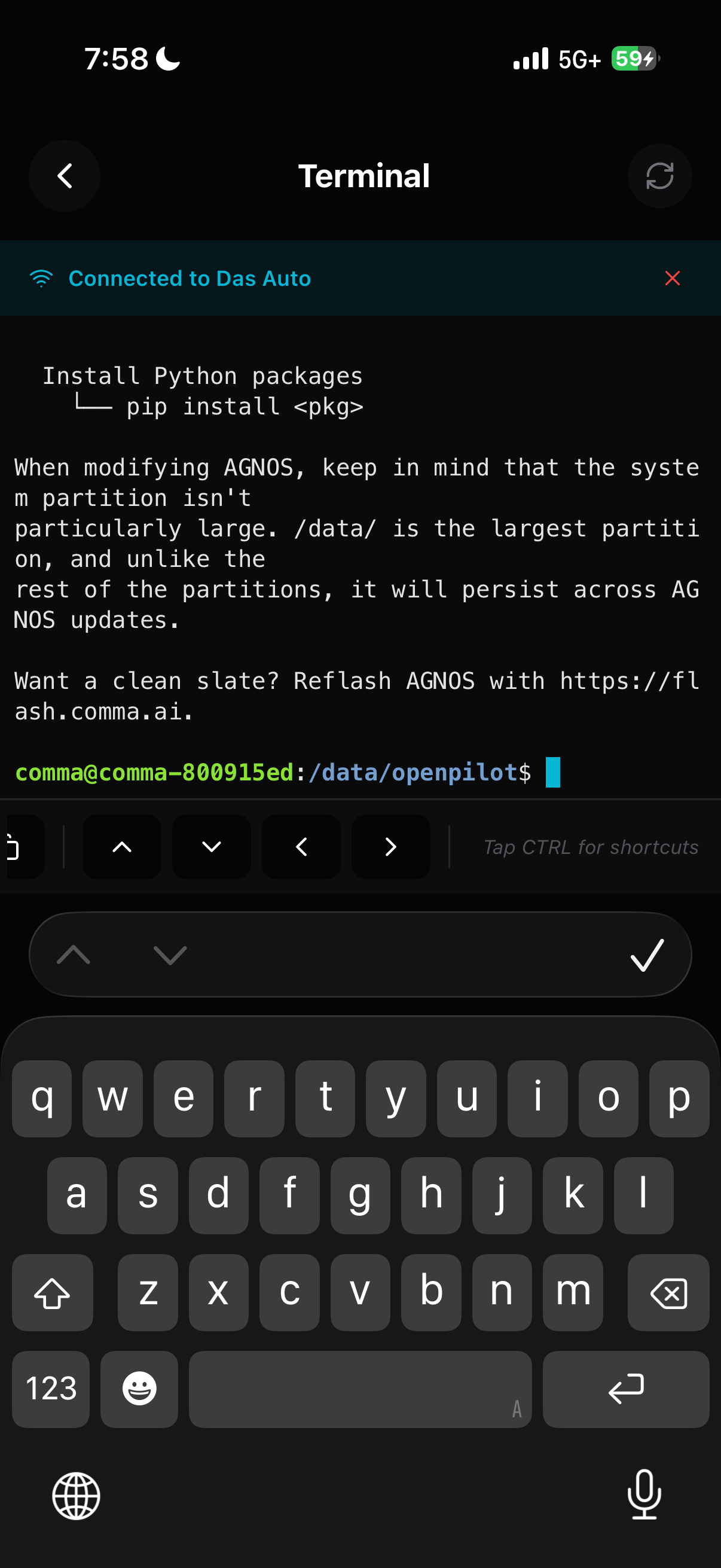
Because typing Linux commands on a mobile phone can be tedious, the konn3kt terminal includes a custom shortcut bar above your native keyboard.
- Modifier Keys: Use the on-screen
ESC,CTRL, andTABbuttons for command-line navigation and auto-completion. - Clipboard: Quick copy and paste buttons are built right into the bar.
- Arrow Keys: Use the directional arrows to scroll through your bash history or move the cursor within a command.
9. Drive Playback & Analysis
What it is:
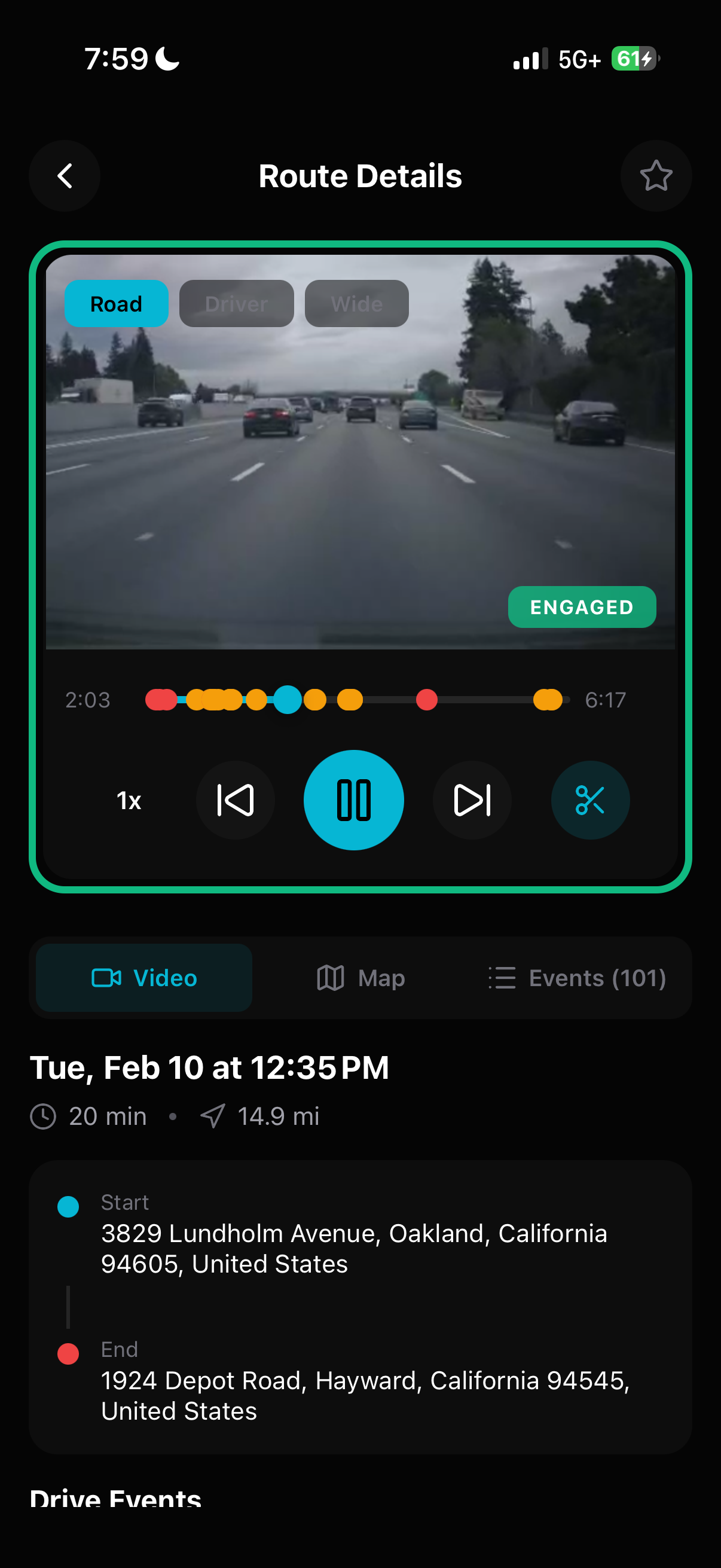
The Route Details view is your mobile command center for analyzing past drives, featuring a synchronized video player and event timeline.
How to use it:
- Camera Switcher: Tap the Road, Driver, or Wide buttons overlaid on the video to switch camera angles during playback.
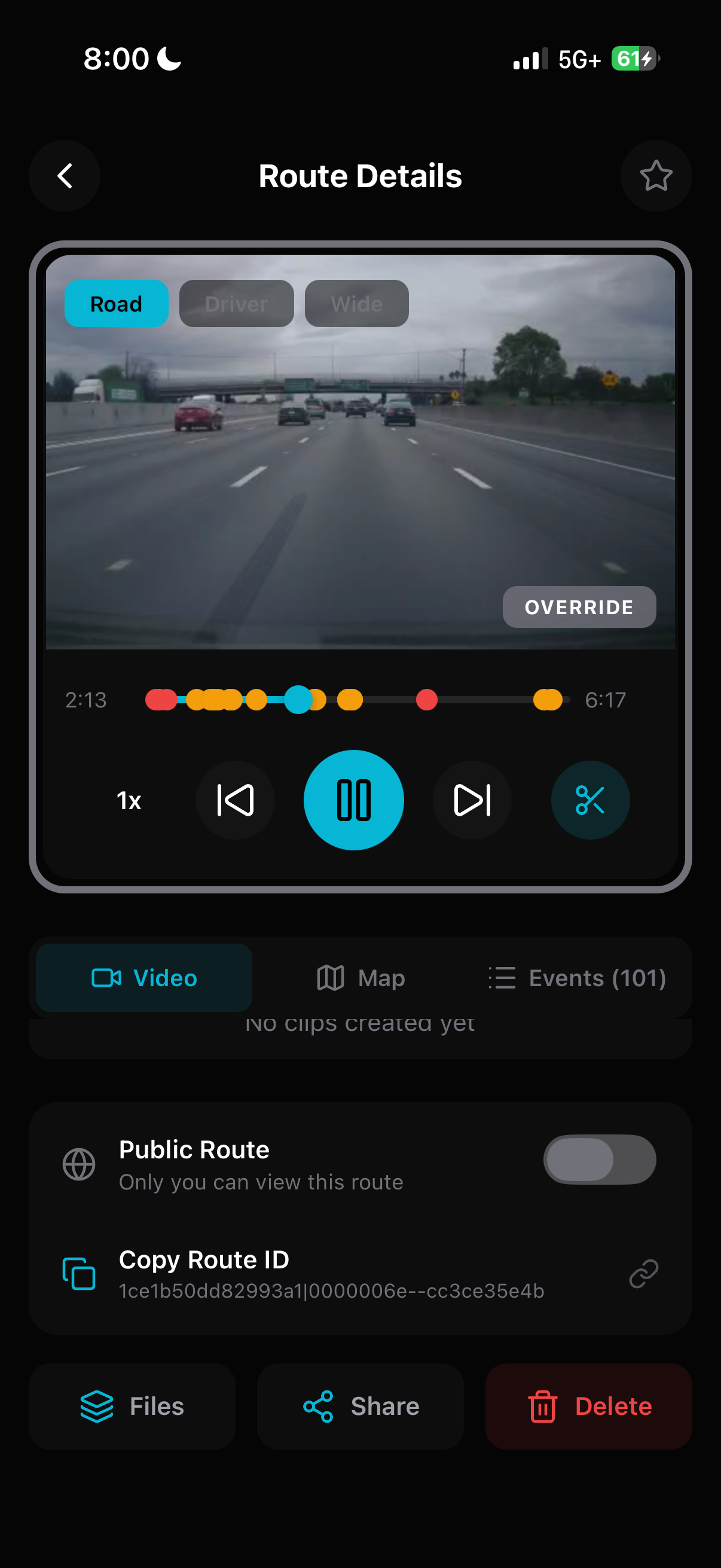
- Interactive Timeline: The colored dots below the video represent events (like engagements or disengagements). Tap any dot to instantly jump the video to that moment.
- View Toggle: Use the tabs below the player (Video, Map, Events) to switch the primary focus of the page. The video will continue playing seamlessly as you navigate the map or scroll through the event list.
9. Drive Playback & Analysis (Continued)
Map View:
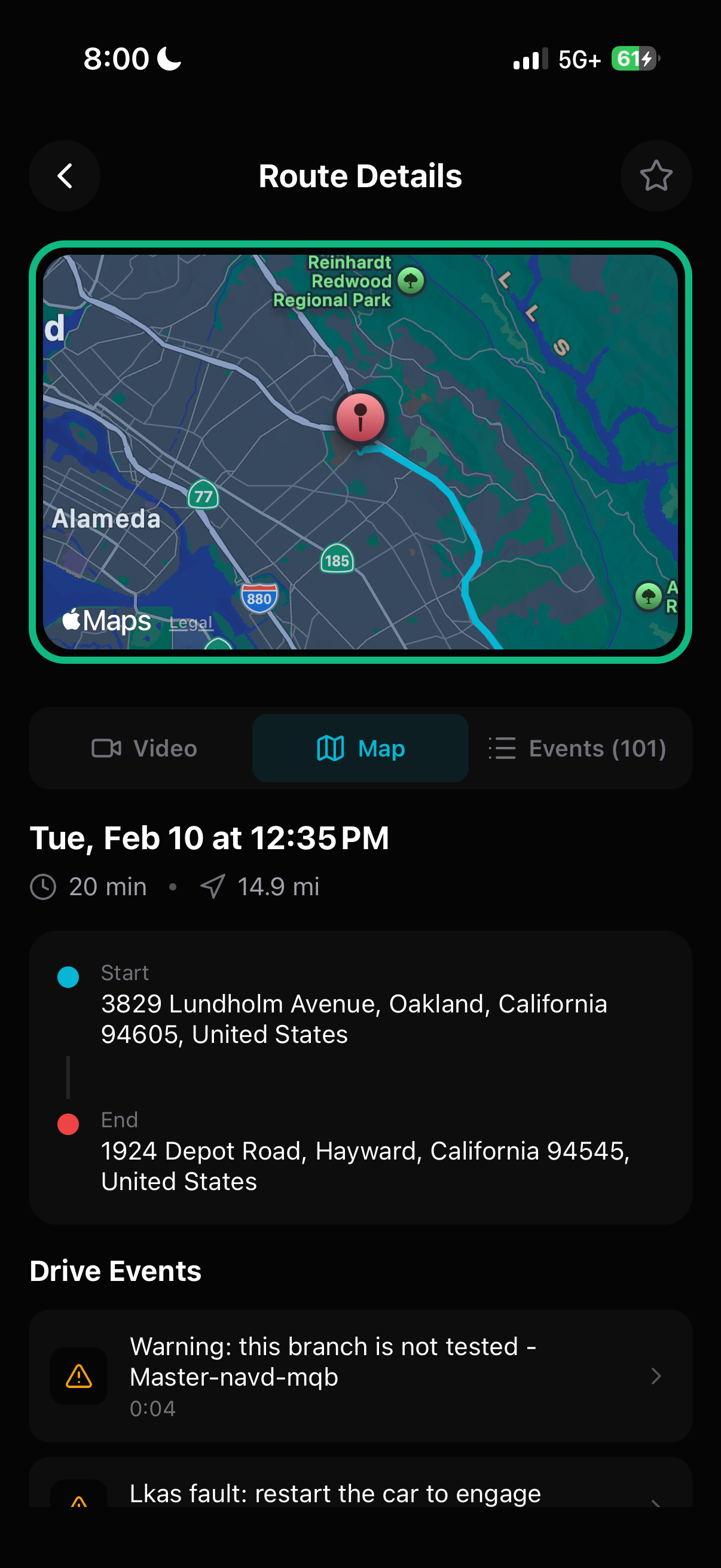
Switching to the Map tab replaces the video player with an interactive Apple Maps view of your route.
- Route Trace: Your vehicle's path is drawn in a bold blue line.
- Current Position: The red pin shows the exact location of the vehicle at the current timestamp in the playback timeline. It moves automatically as the timeline progresses.
- Start & End Data: Below the map, you can view the precise, reverse-geocoded Start and End addresses of the trip.
Events View:
The Events tab provides a granular breakdown of everything IQ.Pilot recorded.
- Event Timeline Bar: A condensed visual representation of the entire drive. The green blocks indicate when IQ.Pilot was engaged.
- Event Tally: A quick summary showing the total number of events, engagements, disengagements, alerts, and user flags.
- Detailed List: A chronological feed of specific events (e.g., "Warning: this branch is not tested", "Lkas fault", "Reverse gear"). Tapping any of these will instantly seek the playback to that exact second.
10. Global Drives List
What it is:
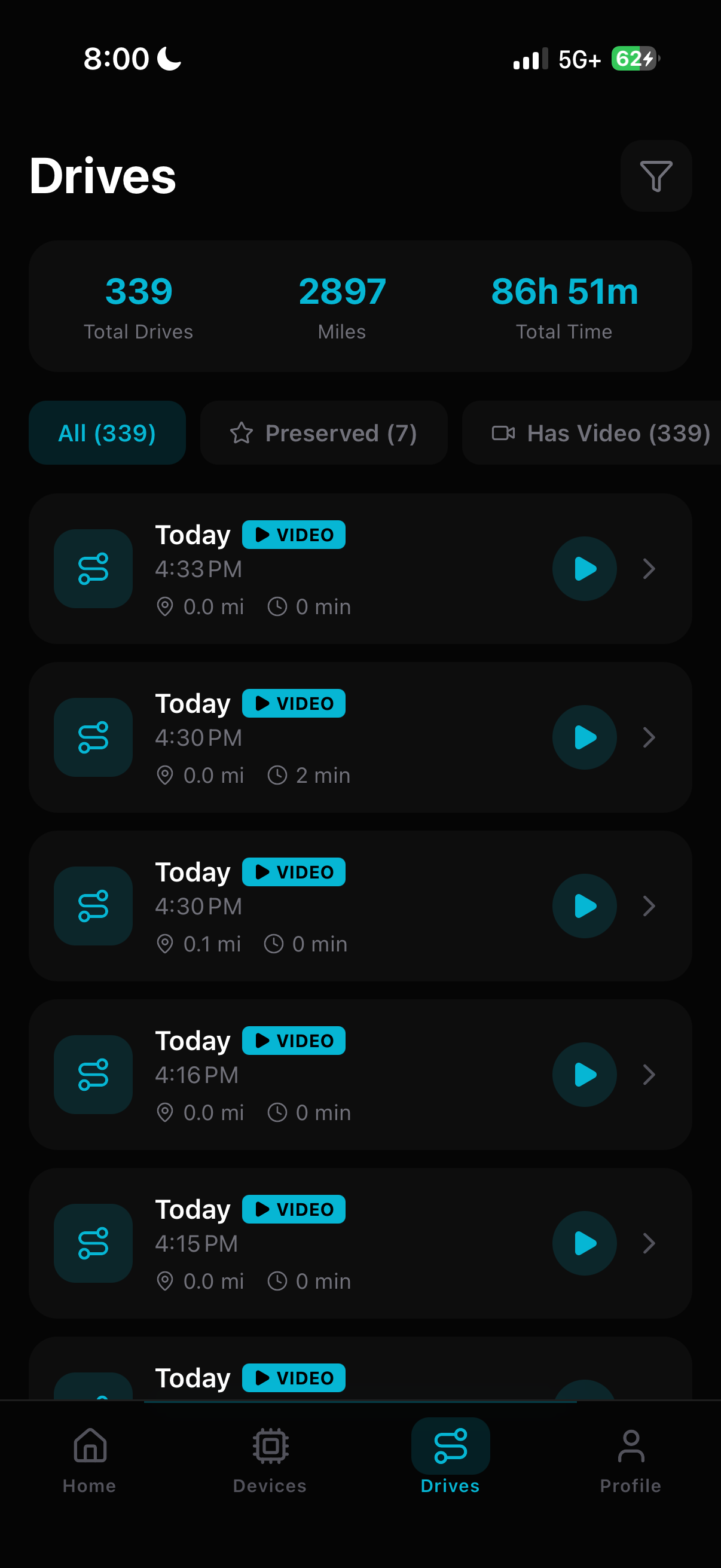
The main Drives tab (accessed from the bottom navigation bar) provides a global view of all your trips across all your devices.
How to use it:
- Aggregate Stats: The top header displays your lifetime Total Drives, Miles, and Total Time across your entire account.
- Filters: Use the buttons to quickly filter by All, Preserved, or routes that have Video available. You can also use the funnel icon in the top right for advanced filtering.
- Play Button: Tap the large blue play icon on any drive card to jump directly into the playback view.
11. Device Settings
Configuration Overview:
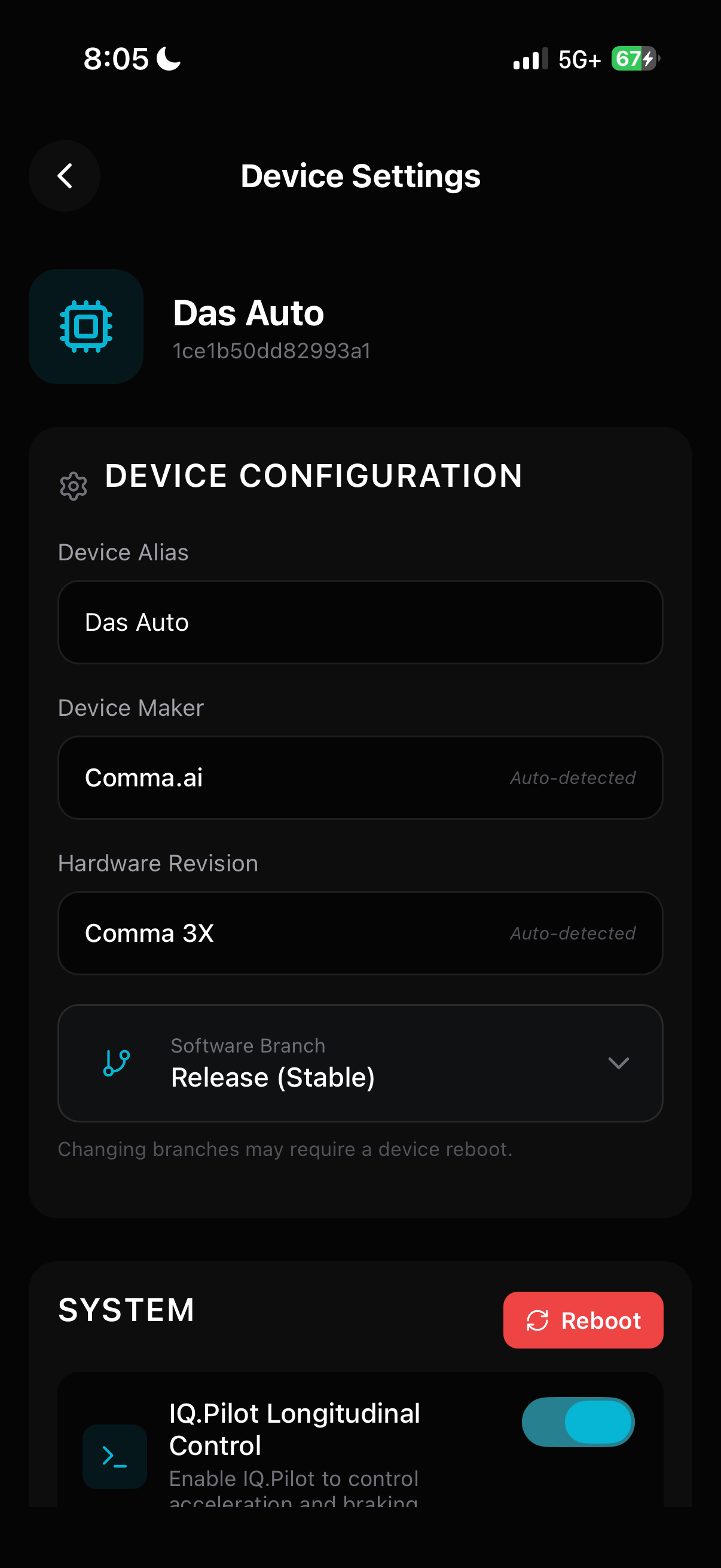
The Device Settings page allows you to deep-tune your IQ.Pilot hardware directly from your phone.
- Device Identity: Quickly change the Device Alias to something recognizable (e.g., "Das Auto").
- Hardware Info: Verify the auto-detected Device Maker (Comma.ai) and Hardware Revision (Comma 3X).
- Software Branch: Switch the active IQ.Pilot branch (e.g., to "Release (Stable)"). Changing this will prompt a device reboot.
System Toggles:
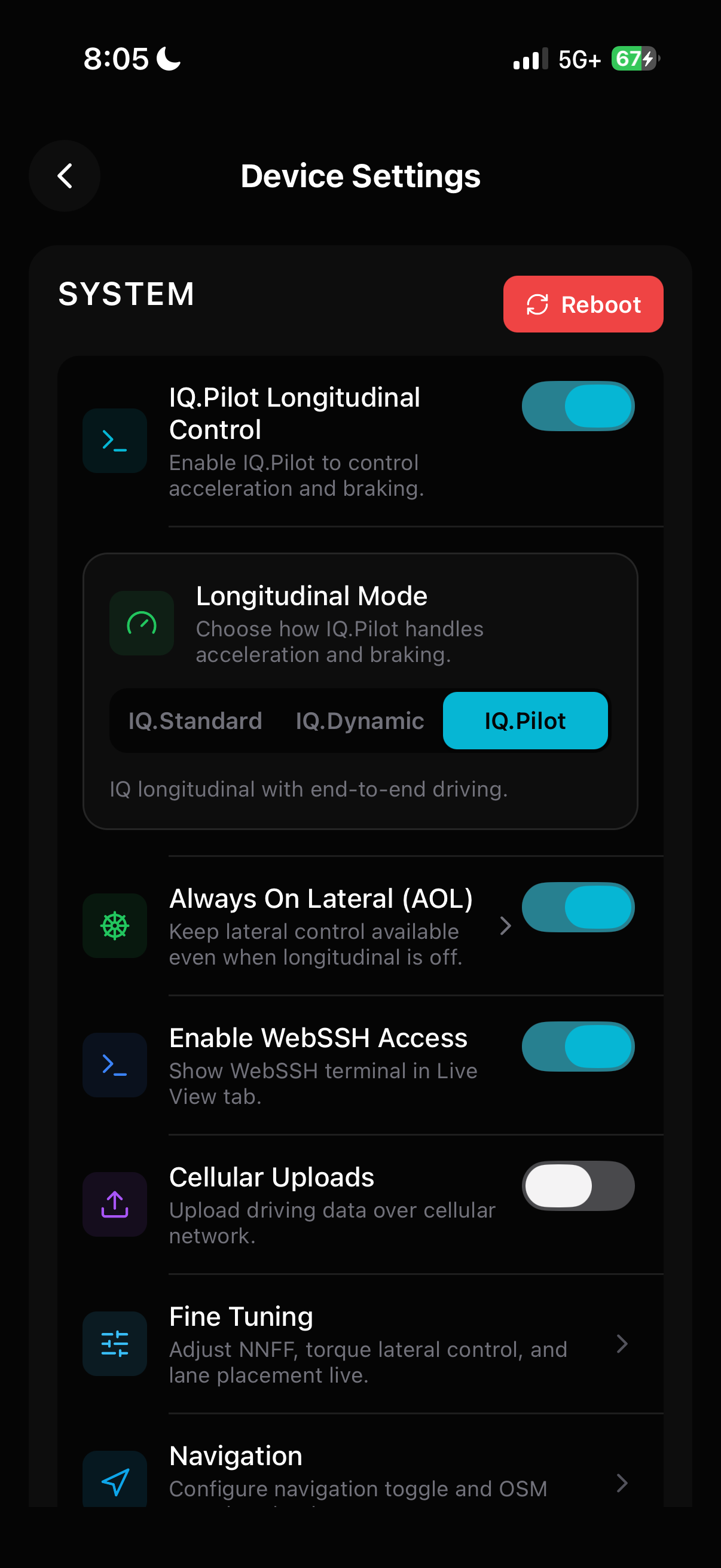
Control exactly how IQ.Pilot behaves on the road.
- IQ.Pilot Longitudinal Control: Toggle whether the system controls your gas and brakes.
- Longitudinal Mode: Choose the driving personality: IQ.Standard, IQ.Dynamic, or the advanced end-to-end IQ.Pilot.
- AOL (Always On Lateral): Keep steering control active even when cruise control (longitudinal) is paused.
- WebSSH & Cellular Uploads: Enable remote terminal access and allow route data to upload using cellular data.
12. Advanced Tuning & Navigation
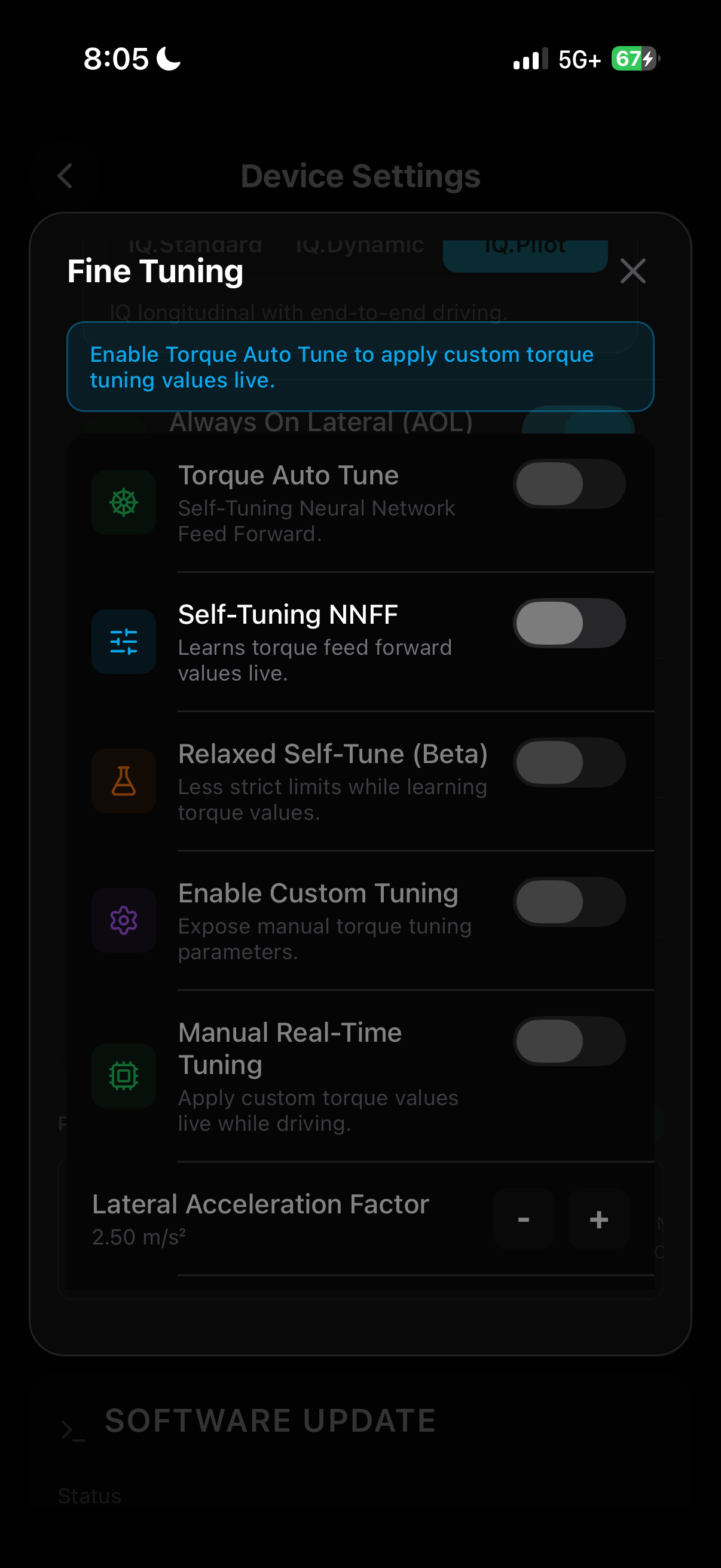
AOL Specifics:
If Always On Lateral is enabled, you can fine-tune its behavior:
- Disengage On Brake Pedal: Choose whether pressing the brake completely turns off steering or just pauses it.
- Toggle With Cruise Main: Allow your car's main cruise button to turn the system on and off.
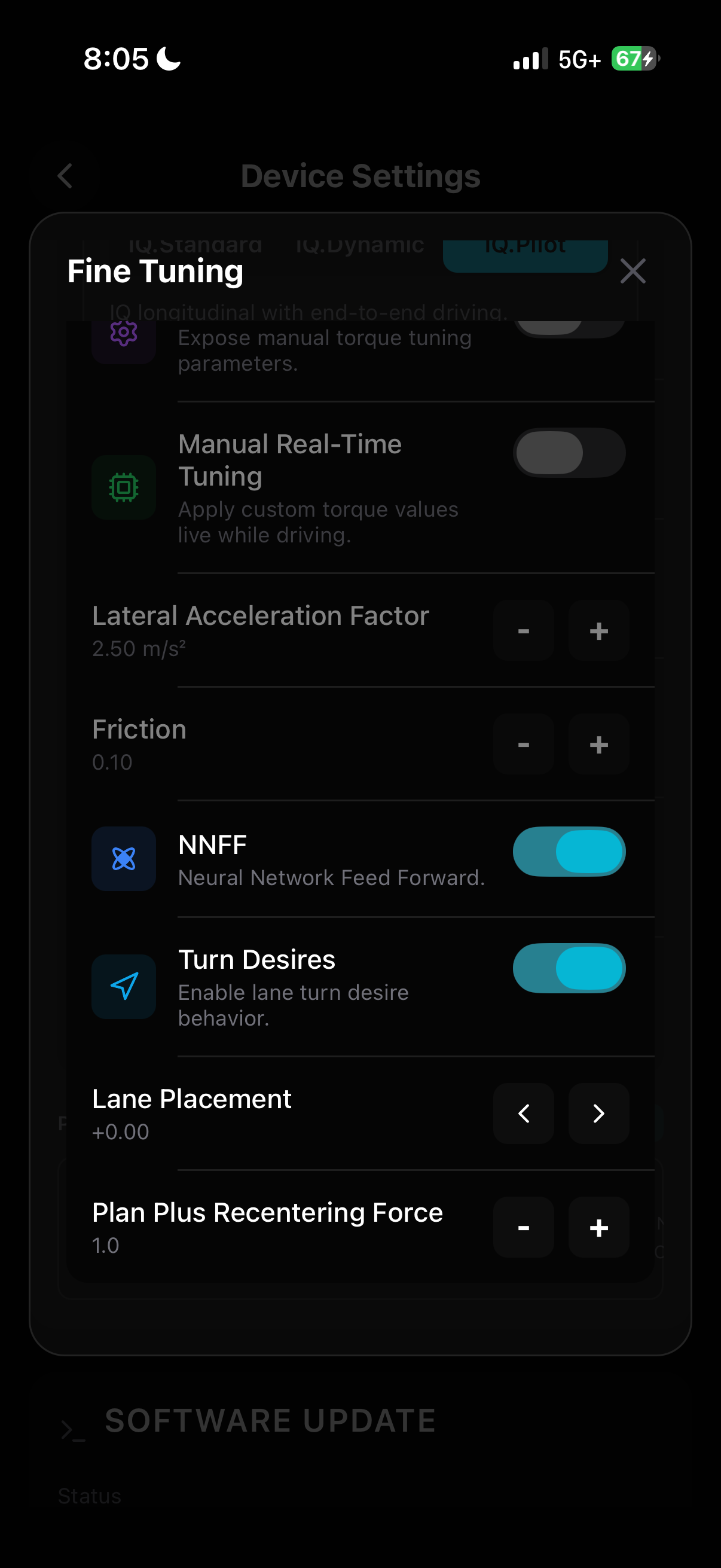
Fine Tuning:
Advanced parameters for tweaking the driving model's feel:
- Self-Tuning: Enable Neural Network Feed Forward (NNFF) to let the device learn torque values live.
- Manual Tuning: Expose raw variables like Lateral Acceleration Factor and Friction.
- Lane Placement: Bias the car's position slightly left or right within the lane.
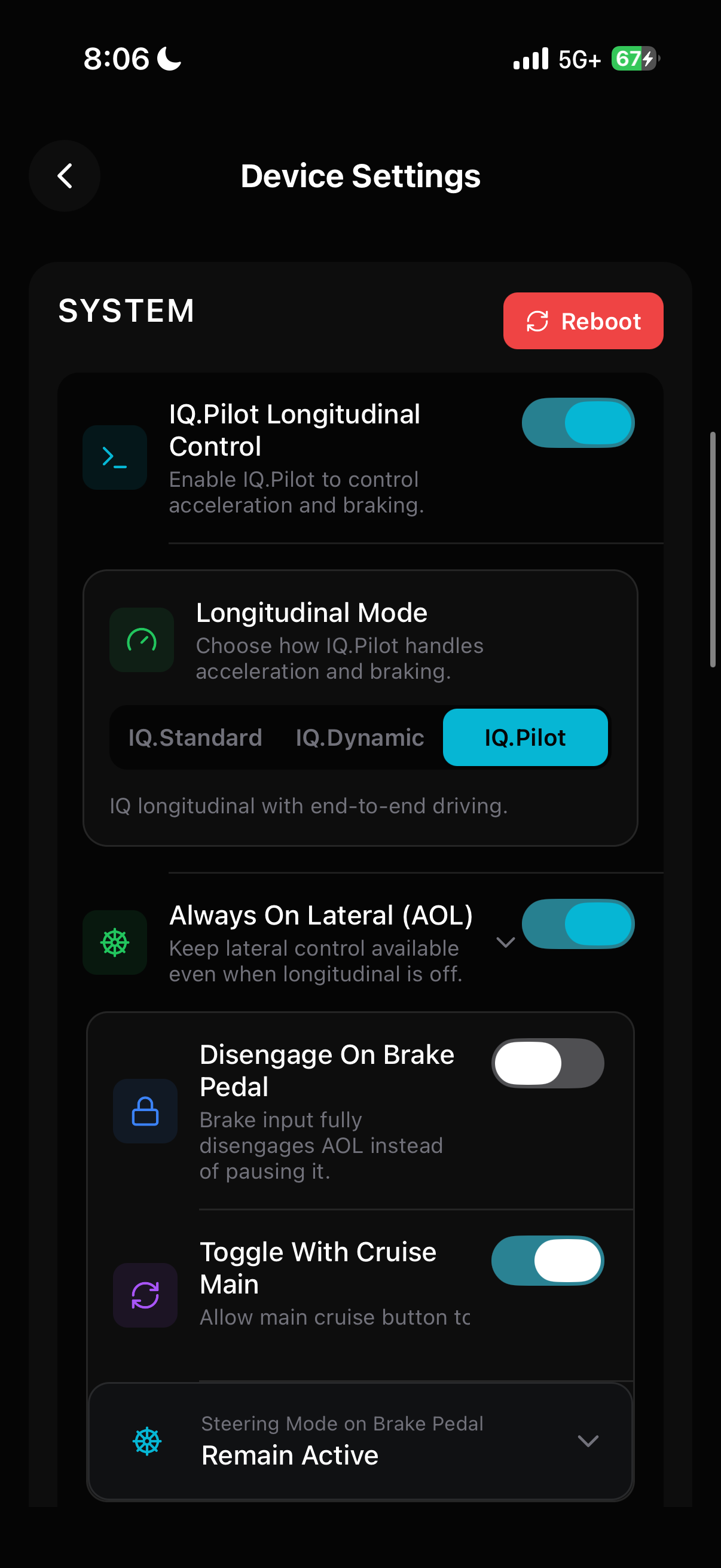
Navigation Setup:
Configure offline routing data.
- OSM Maps: Select your Country and State (e.g., United States, California) and tap Start Download to save map data directly to the device for offline use.
13. Software Updates & Backups
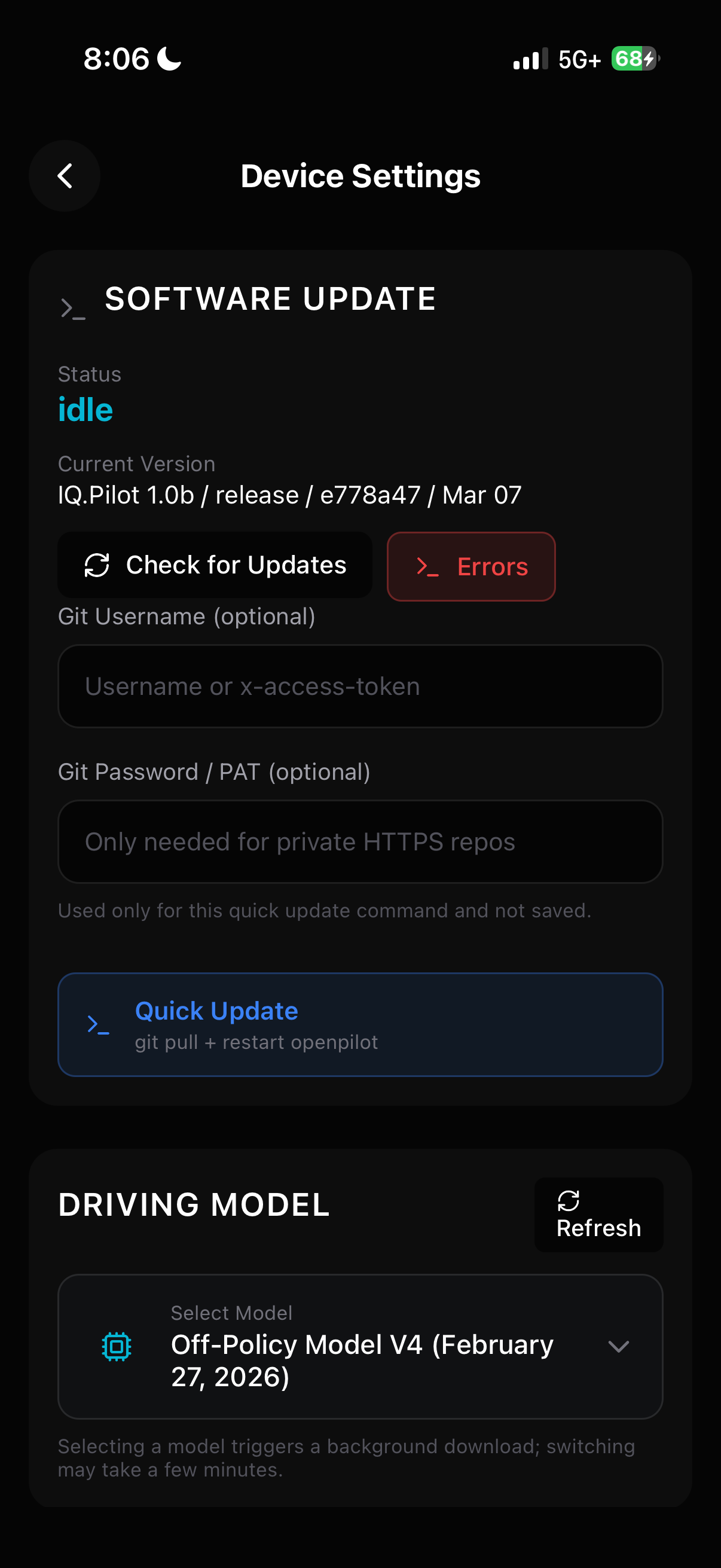
Software Management:
- Updates: Tap Check for Updates to pull the latest IQ.Pilot code. You can also view update Errors if a pull fails.
- Private Repos: Enter a Git Username (or token) and Password if you are pulling an experimental branch from a private repository.
- Quick Update: Forces a
git pulland automatically restarts the UI.
Backups & SSH:
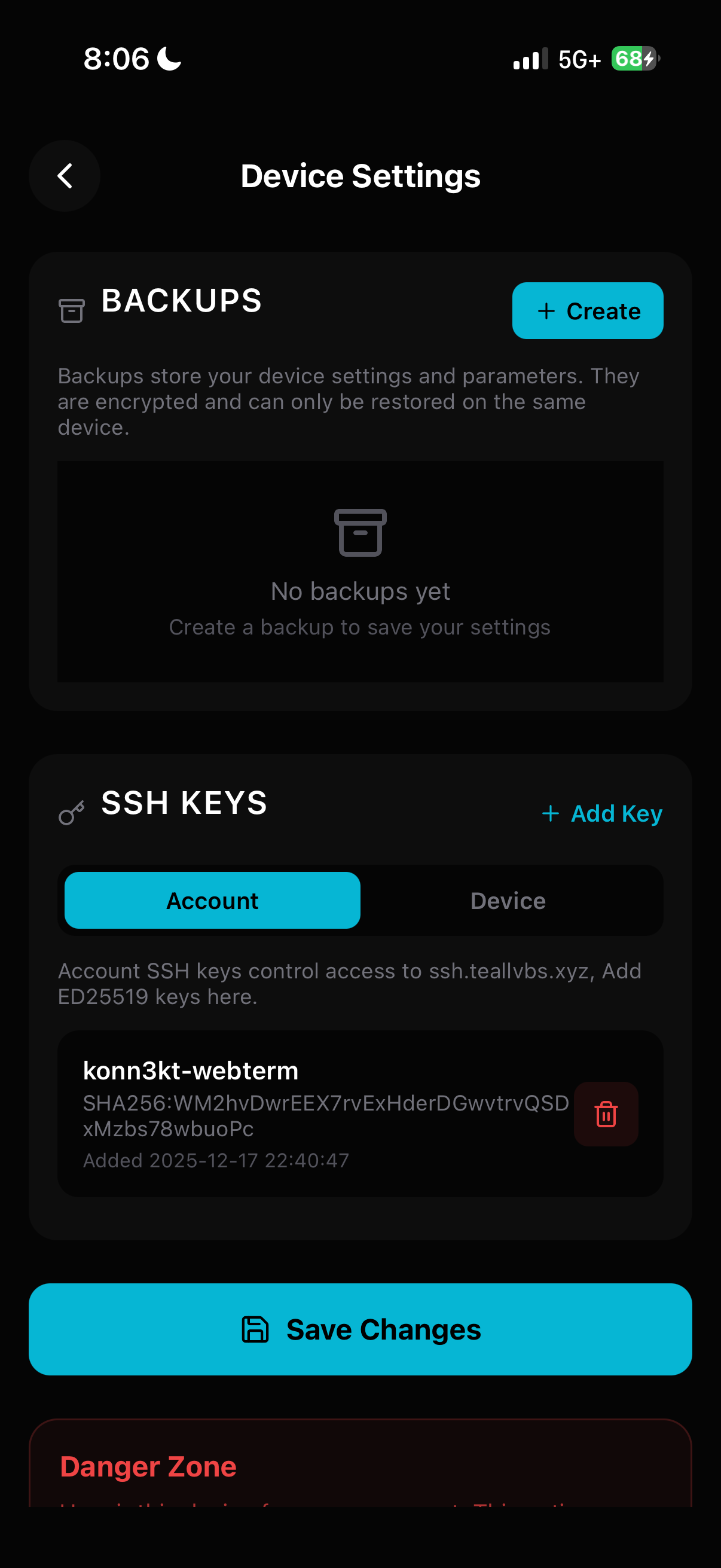
- Device Backups: Securely save your current configuration to the cloud. Backups are encrypted with the device's private key.
- SSH Keys: Manage the keys required for Web Terminal access. You can view keys linked to your konn3kt account or keys stored directly on the hardware.
- Danger Zone: The red Unpair Device button permanently removes the hardware from your account.
14. Profile & Security
Profile Dashboard:
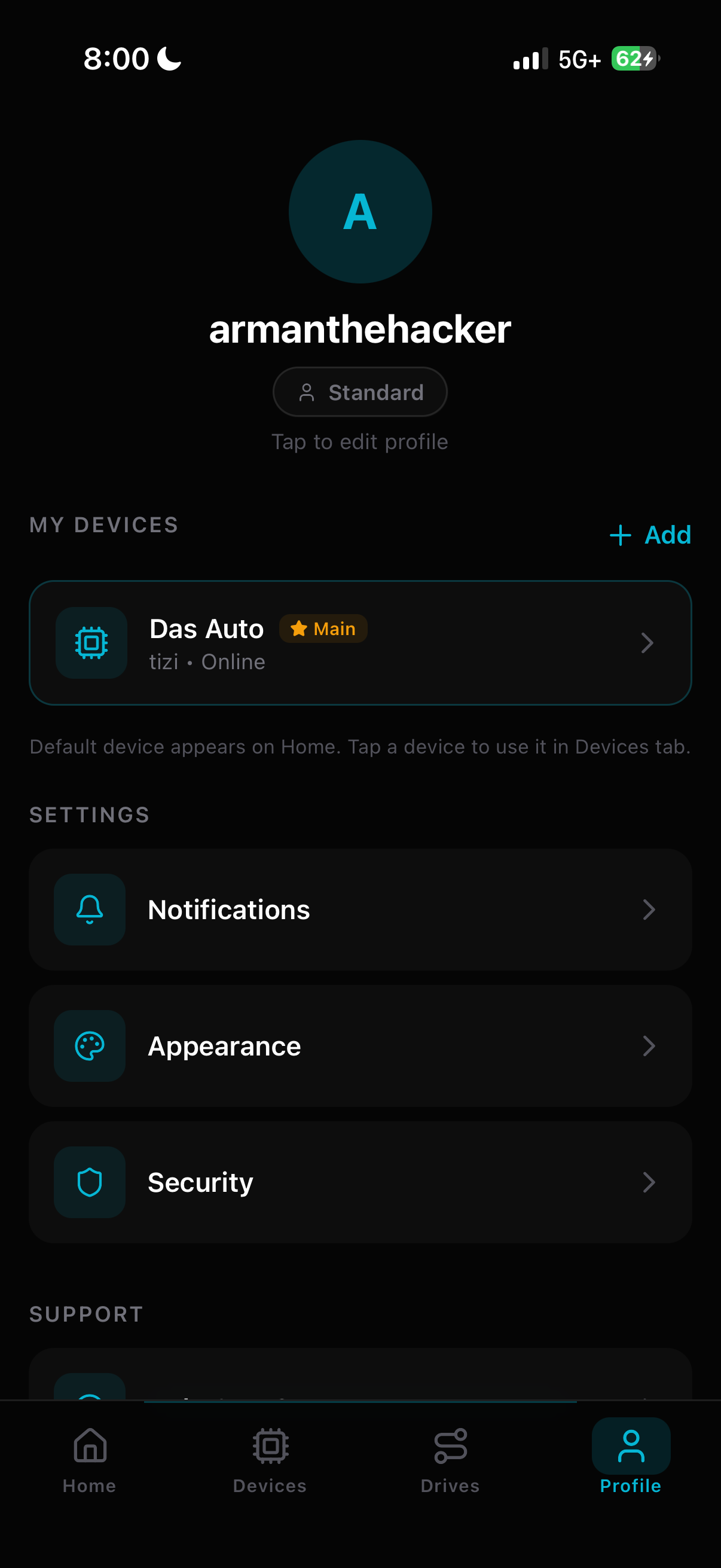
The Profile tab is where you manage your konn3kt account.
- My Devices: Quickly switch your "Main" default device or tap + Add to pair a new one.
- Settings: Access global account preferences for Notifications, Appearance, and Security.
Push Notifications:
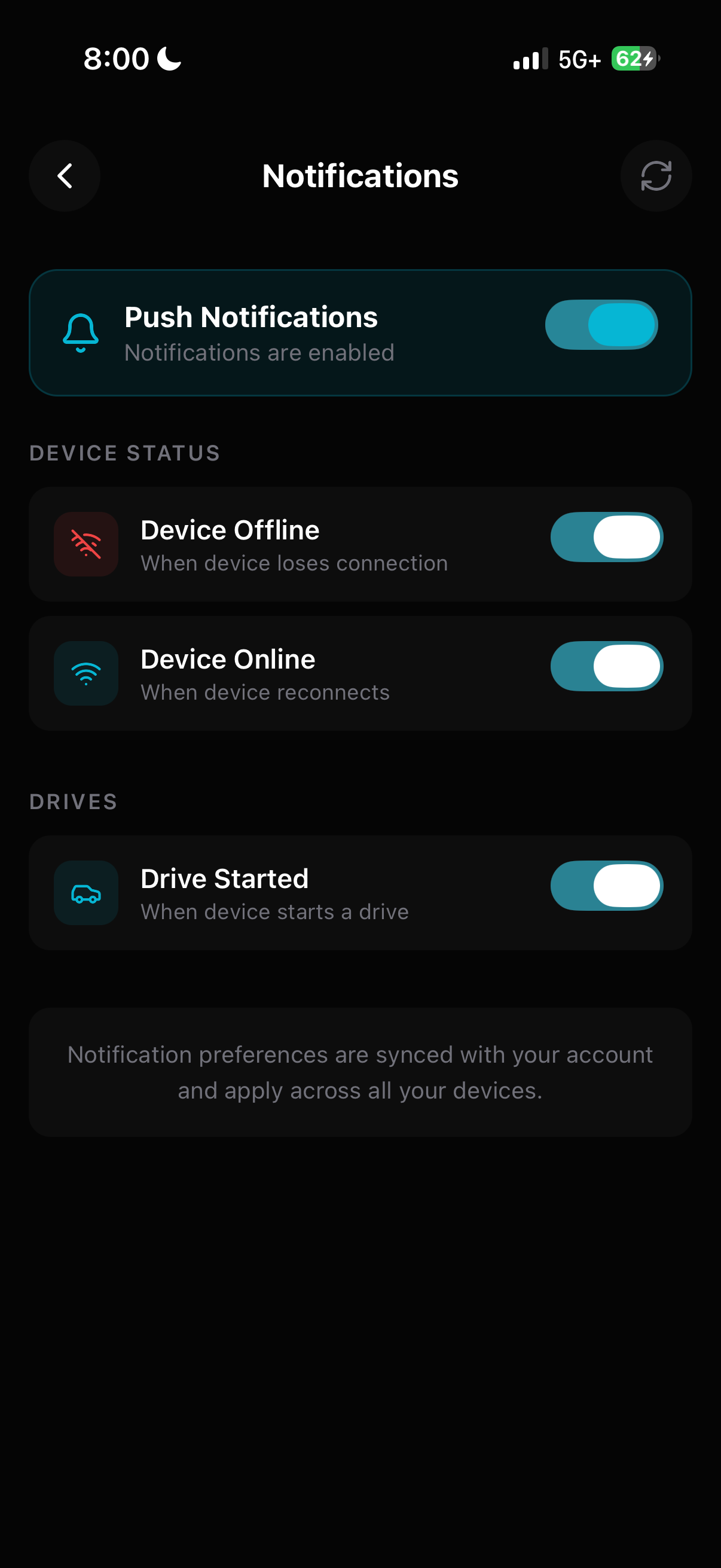
Configure what alerts konn3kt sends to your phone.
- Device Status: Get notified instantly if your device goes Offline or comes back Online.
- Drives: Receive an alert the moment your vehicle starts a new drive.
Mobile Security:
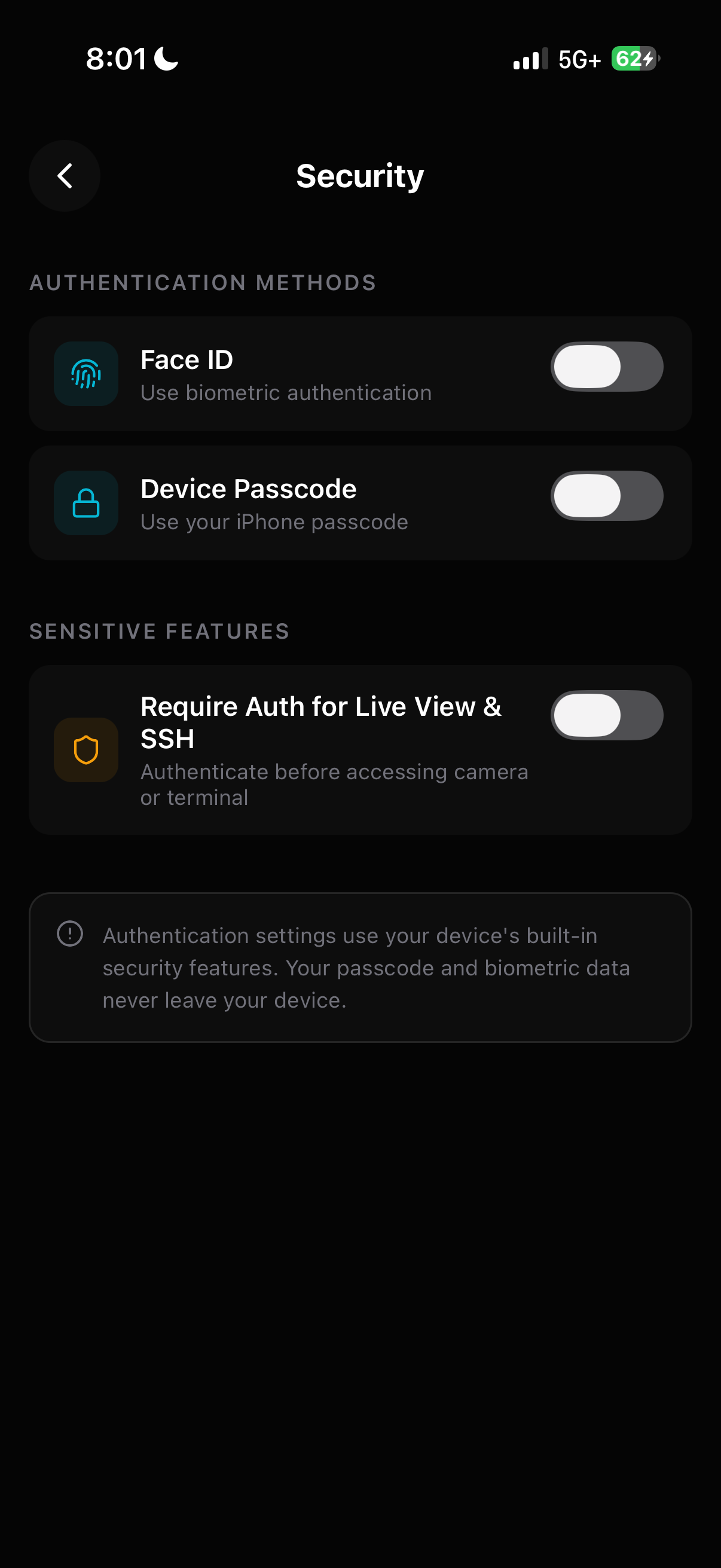
Protect your sensitive data and remote controls.
- Biometrics: Enable Face ID or Device Passcode to require authentication before opening the app.
- Sensitive Features: Toggle Require Auth for Live View & SSH to ensure no one can stream your cameras or access the terminal without a secondary biometric scan.
15. Profile Details & Appearance
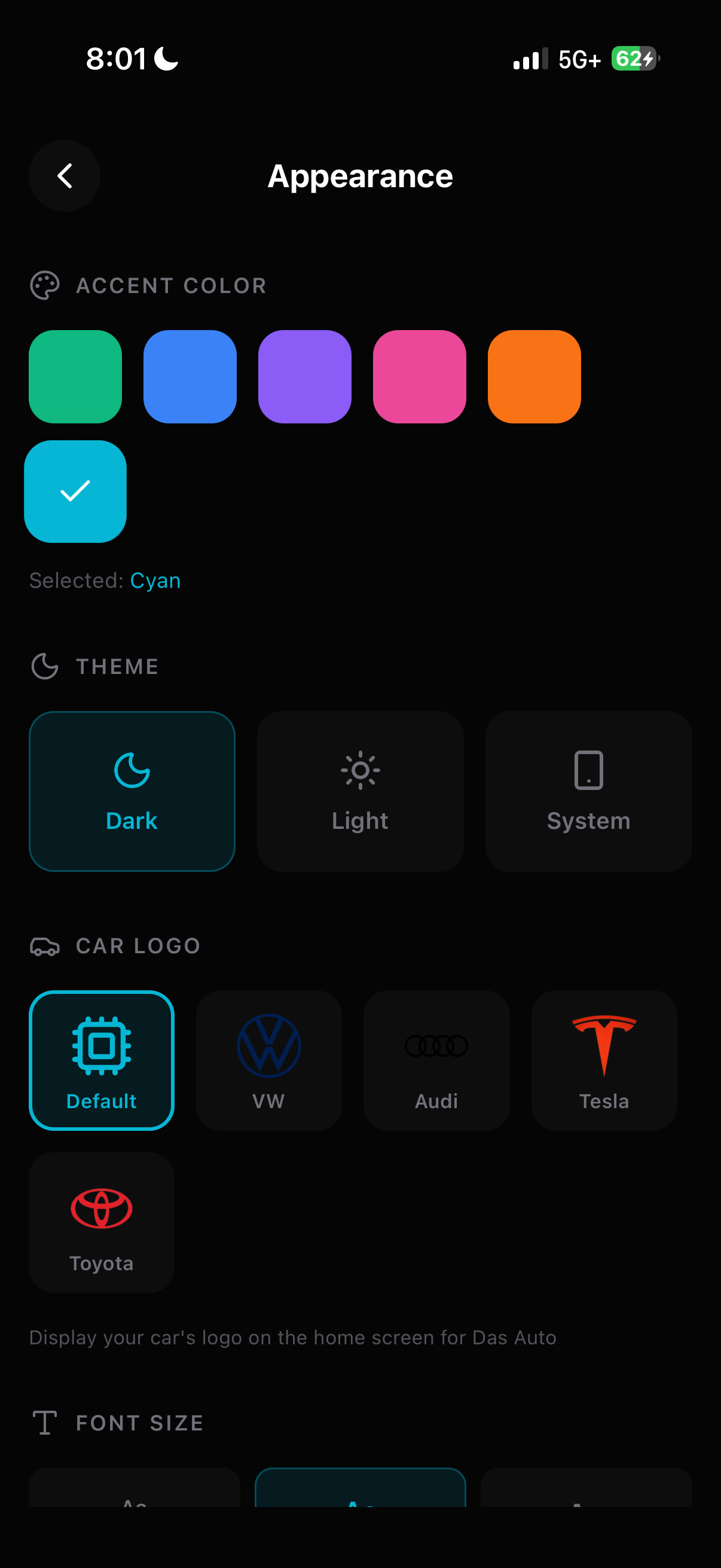
Appearance Settings:
Customize how the app looks on your device.
- Accent Color: Choose a personal color (like Cyan) that highlights buttons, icons, and route lines.
- Theme: Force Dark mode, Light mode, or let it match your system settings.
- Car Logo: Select an icon (Default, VW, Audi, Tesla, Toyota) to display next to your vehicle's alias.
- Font Size: Adjust the text size (Small, Medium, Large) for readability.
- Picture-in-Picture: Enable this to let live video feeds continue floating on your screen even if you minimize the app.
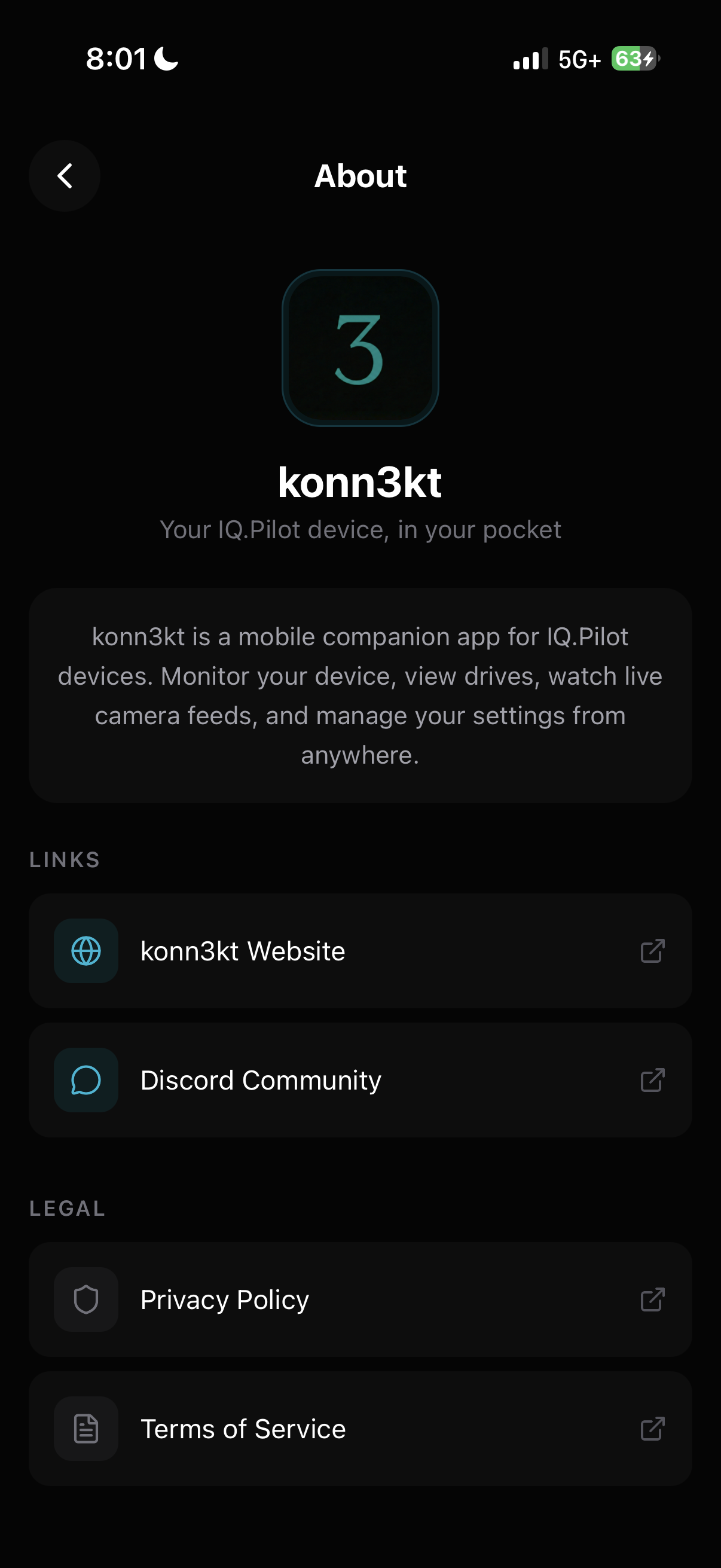
About App & Links:
The About section provides quick external links and app info.
- External Links: Jump directly to the konn3kt Website or join the Discord Community.
- Legal: Review the Privacy Policy and Terms of Service.
- Version: The current app version (e.g., v1.4.4) is displayed at the bottom of the profile page.
16. Snapshots & Self-Hosted Nodes
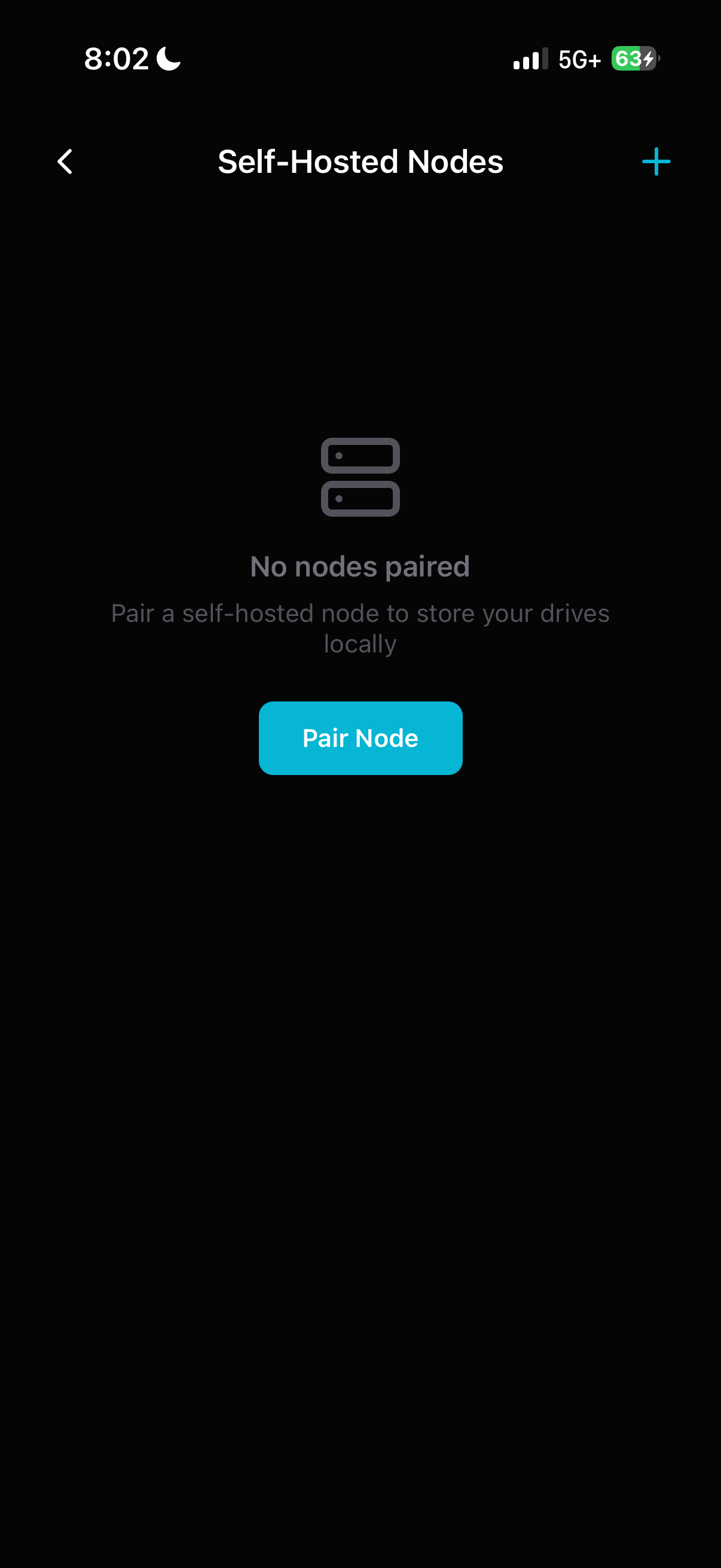
Self-Hosted Nodes:
If you prefer not to use konn3kt's cloud storage, you can link your own server.
- Pair Node: Tap this to scan a QR code from your self-hosted instance. Once paired, your device will upload drives directly to your hardware while still using the konn3kt interface for playback.
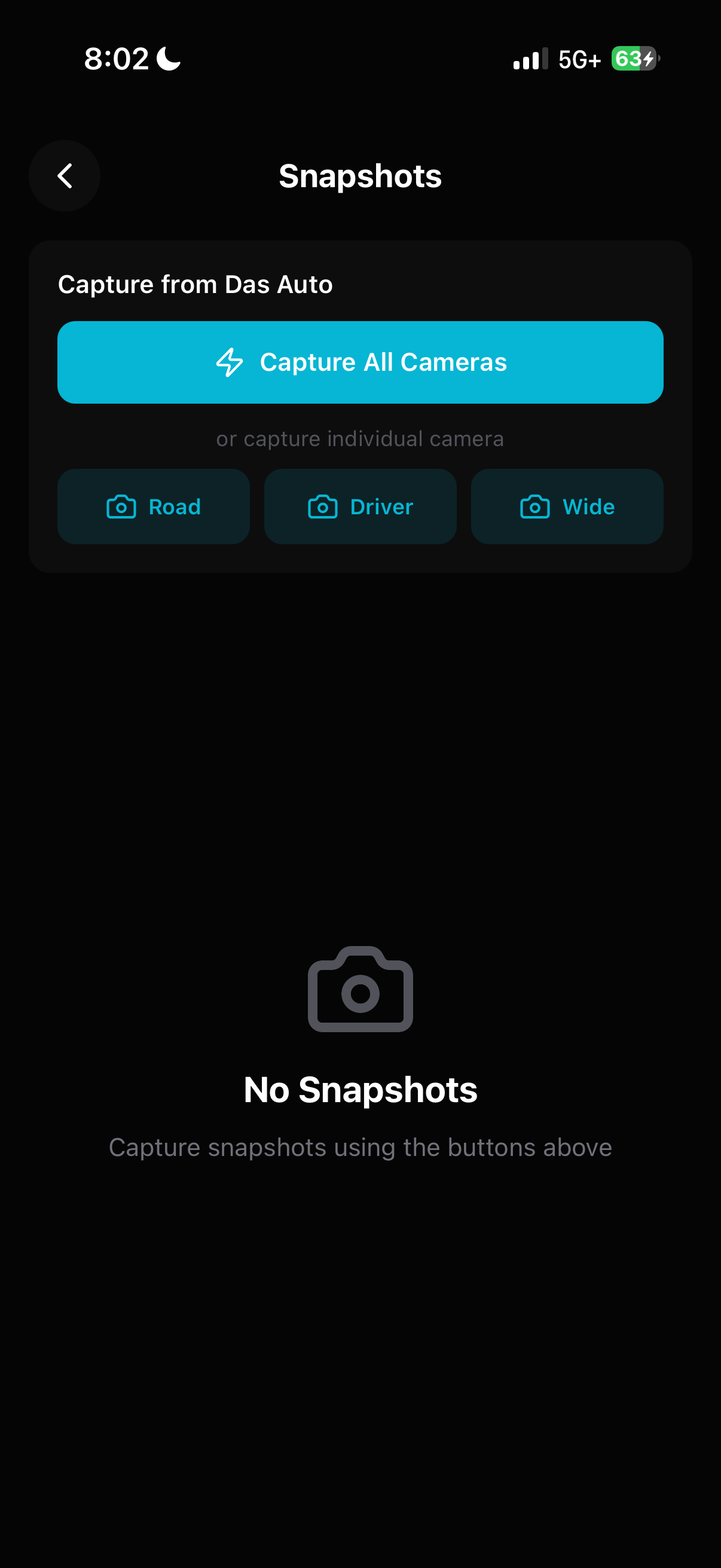
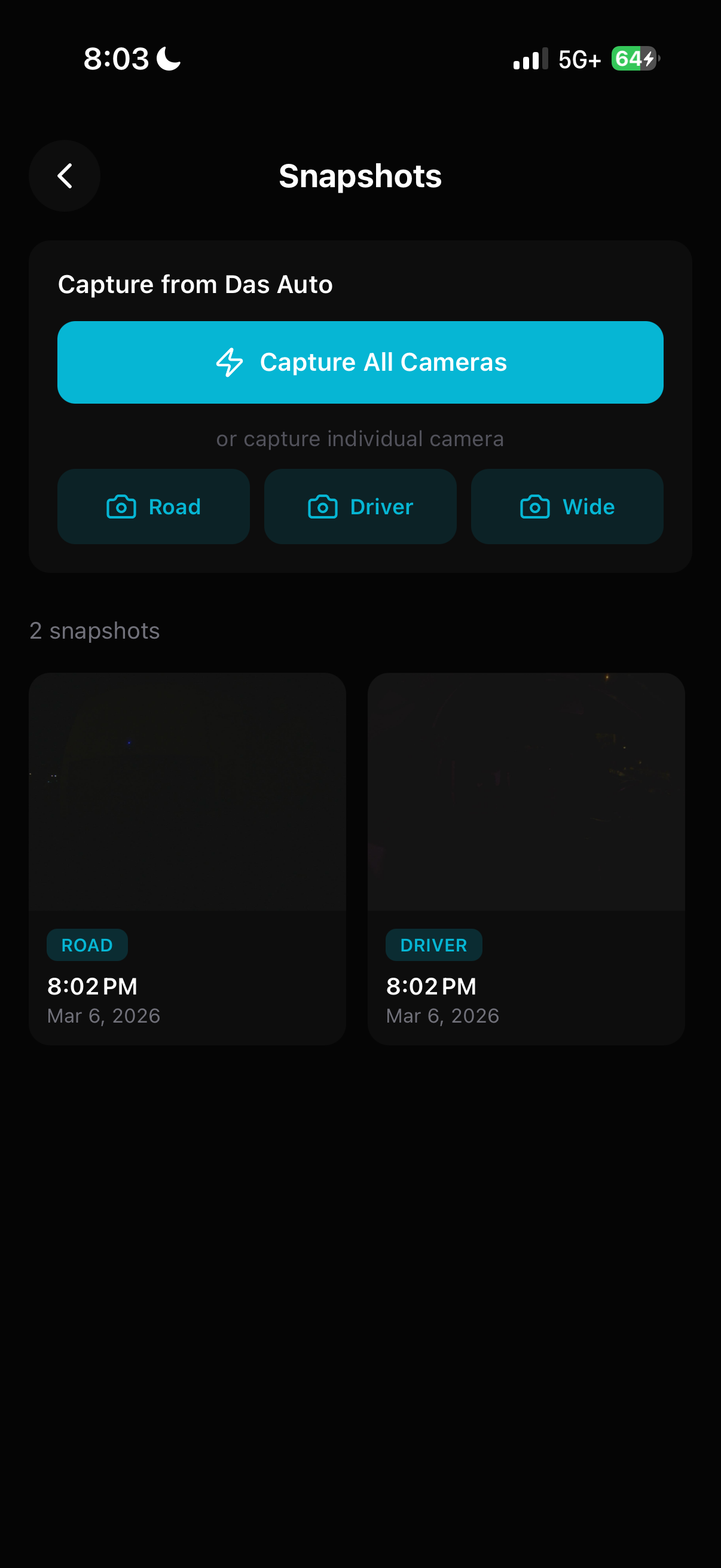
Capturing Snapshots:
Pull high-resolution images from your vehicle at any time.
- Capture Controls: Tap "Capture All Cameras" or specifically request an image from the Road, Driver, or Wide camera.
Viewing Snapshots:
Saved images appear in a gallery.
- Gallery: Images are labeled by camera type (e.g., ROAD, DRIVER) and timestamped. Tap any image to view it full screen and save it to your phone.
17. Advanced File Browser & Debugging
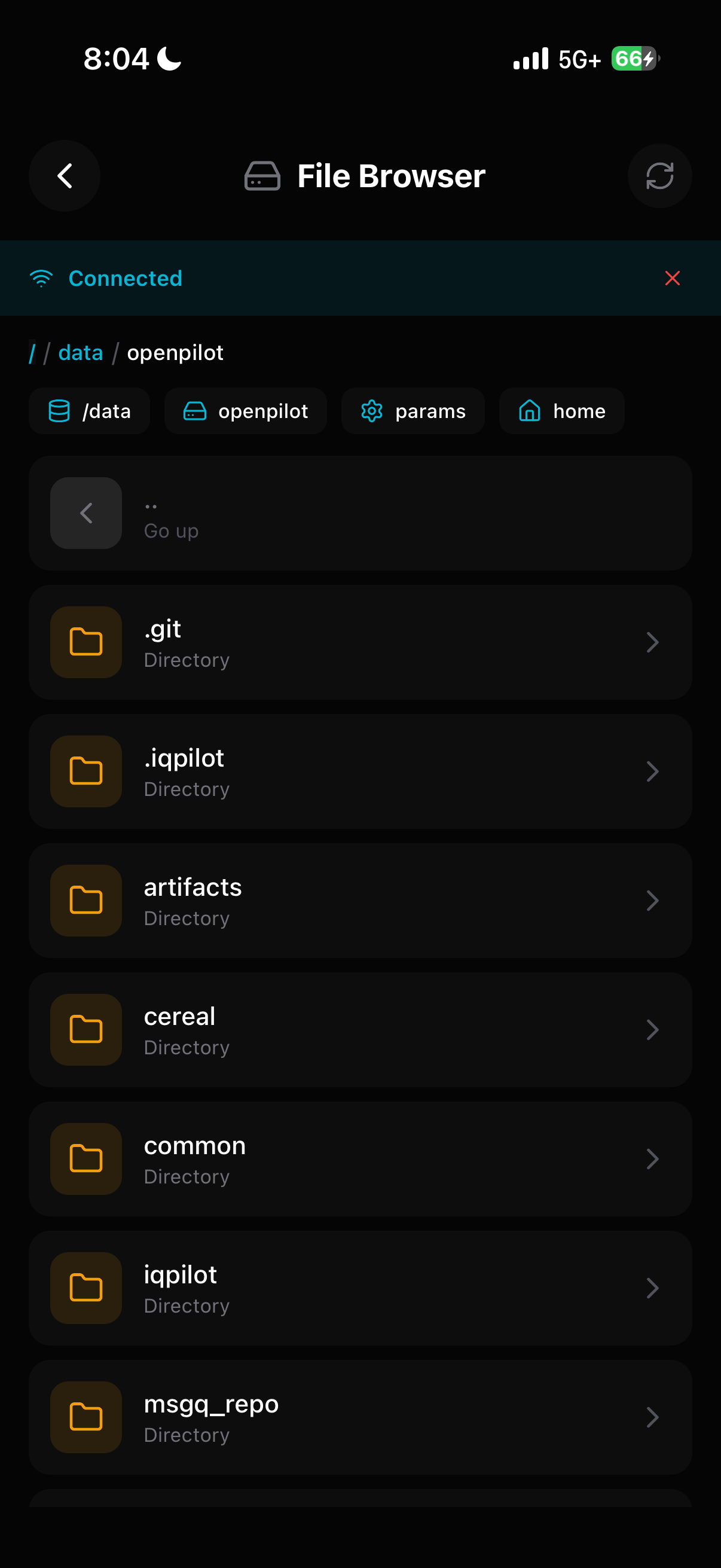
Local File Browser:
Navigate your IQ.Pilot device's internal filesystem directly from your phone.
- Breadcrumbs: The top bar shows your current path (e.g.,
//data/openpilot). - Quick Links: Jump instantly to common directories like
/data,openpilot, orparams. - Navigation: Tap folders (like
.gitorcereal) to explore, or use the.. Go upbutton to step back.
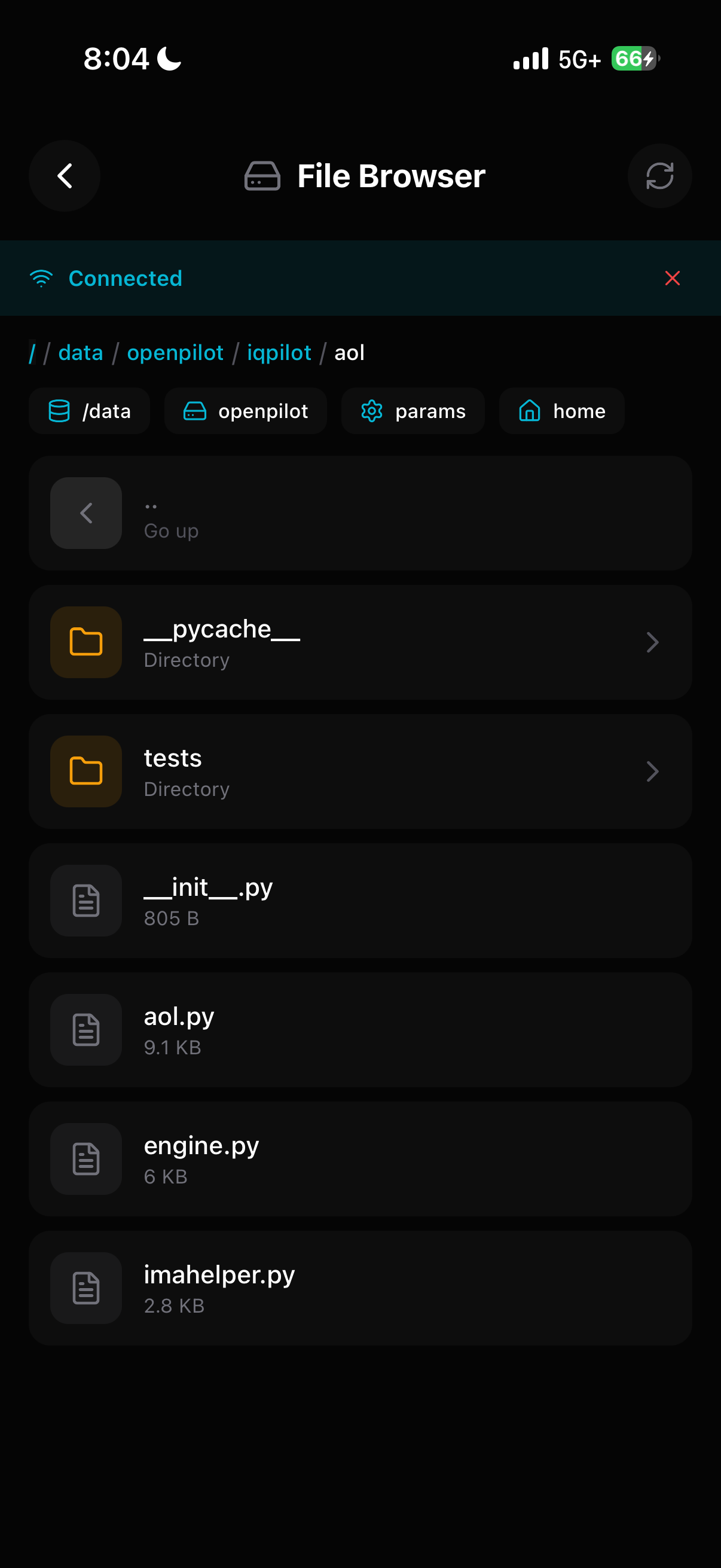
File Interaction:
When you navigate into specific code directories (like iqpilot/aol), you can see the python files (.py).
- File Info: Displays file size (e.g., 9.1 KB). Tapping a file gives you options to download, delete, or view it if supported.
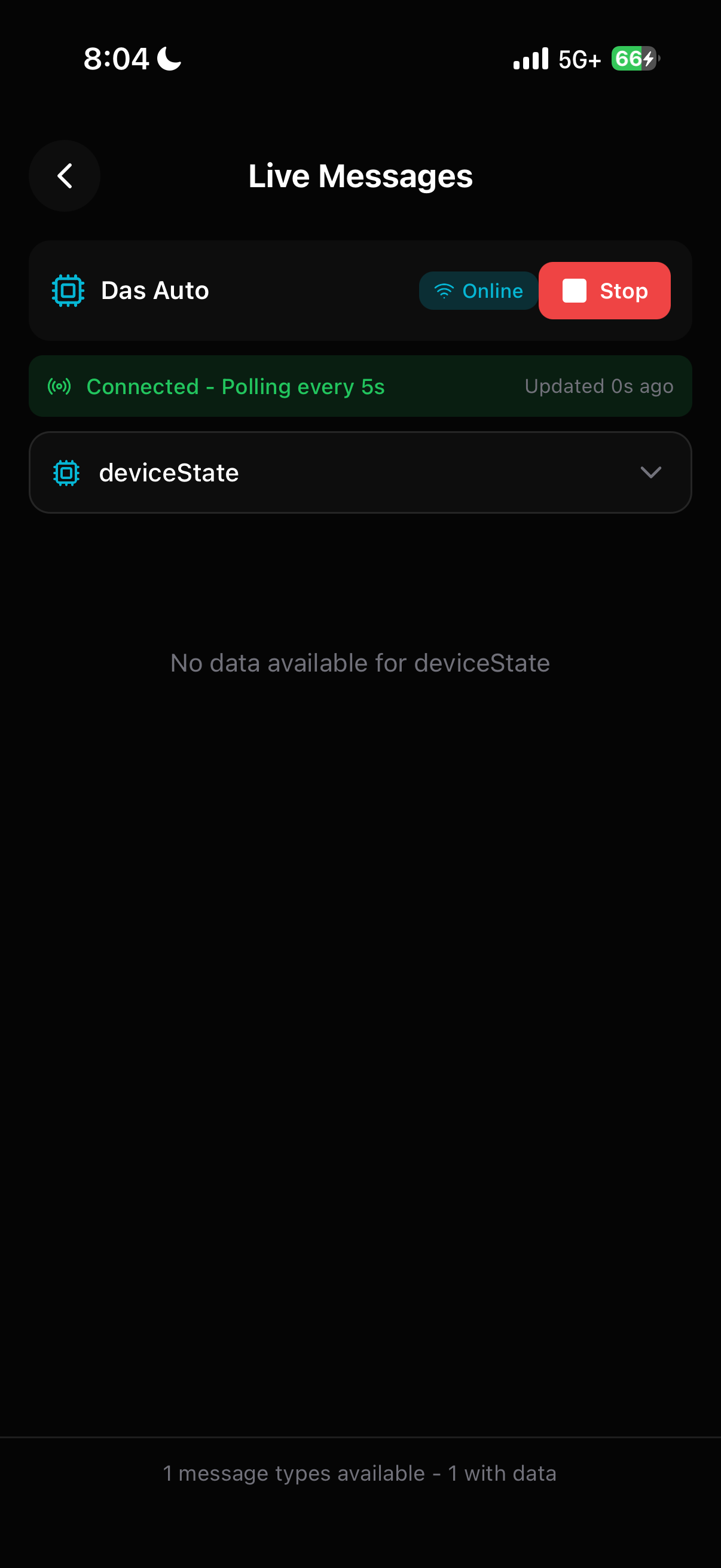
Live Messages:
Subscribe to the raw system event bus.
- Polling: Displays the active connection status and polling rate (e.g., every 5s).
- Message Types: Select specific system messages (like
deviceState) to view the raw JSON data stream coming from your vehicle.
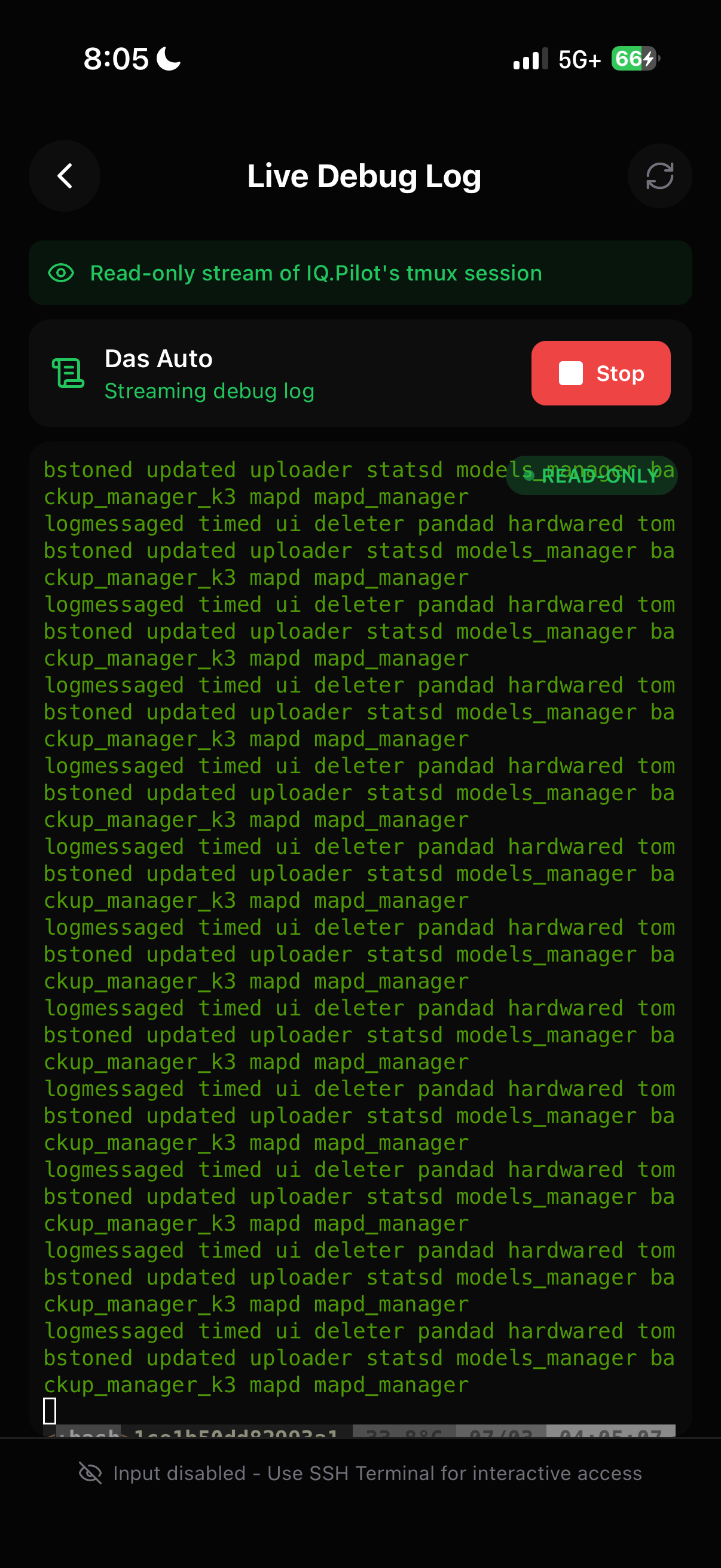
Live Debug Log (tmux):
Watch the raw system output as IQ.Pilot operates.
- Read-only Stream: This view continuously tails the internal
tmuxsession. It is extremely useful for catching immediate crash errors or observing boot sequences without needing to type SSH commands.